Analogies Plus Tech Can Deepen Understanding
A MiddleWeb Blog
 I love middle school. I often joke that being a teacher of early adolescents is about a 50/50 split between laughter and learning. Half of our time is spent trying not to laugh at what our students say and do…and the other half is spent being fascinated at their natural ability to learn and to teach one another.
Recently, I was visiting a classroom where a student named Calvin seemed to be growing increasingly frustrated during his teacher’s well-prepared lesson on unicellular and multicellular organisms. The teacher was using great questions, examples, pictures, and definitions, but Calvin just didn’t seem to be getting it.
 When the bell rang for lunch, the student next to Calvin leaned over to him and said… “It’s kind of like the difference between a jellyfish and a shark. Jellyfish are only made up of one thing – slime. All they do is float around and sting stuff. But sharks are cool…they’re more complicated. They have brains, bones, and guts.”
Calvin, who had initially struggled with the concept, scratched his head, and then added… “So…it’s kind of like a slug compared to a snake. Slugs are much more simple, ain’t they?”
I did some double-checking after class on what unicellular and multicellular organisms really were. It turned out that neither student’s example of unicellular was technically correct…nor are jellyfish made of ‘slime.’
Yet their conversation helped to illustrate a key aspect of student learning – adolescent brains are constantly working to make sense of new information and do it by making connections to things that we already know and understand (Siegel, 2015).
So slime notwithstanding, with that goal in mind here a few analogy-related tips and tech tools for the classroom.
Teaching Content Using Analogies
Teachers can use well-crafted analogies to help students make connections and deepen their understanding of new concepts.
For example, based on this summer’s latest Star Trek movie and an idea I borrowed from Robert Marzano (2001), I decided to design simple slides in something like PowerPoint, Keynote or Google Slides to introduce the complex structure and components of the cell.
The goal was to help students compare and connect the new information to the USS Enterprise. I began briefly explaining how the cell’s nucleus is like the ship’s control bridge. After all…both the nucleus and the control bridge help run the system.
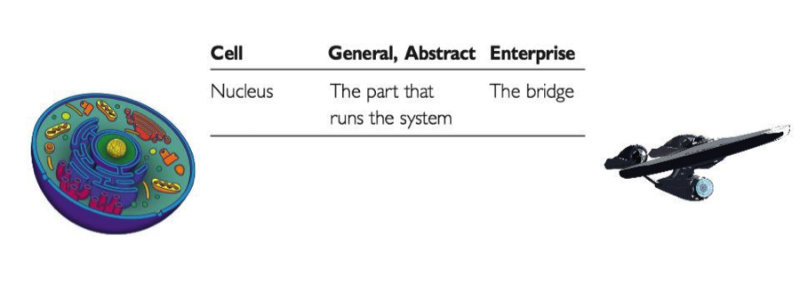 Next I explained that, in a cell, the membrane is what regulates what passes in and out of the cell. Students are asked to work in pairs to determine the missing part of the analogy by answering the following question: What part of the USS Enterprise is most like the cell membrane?
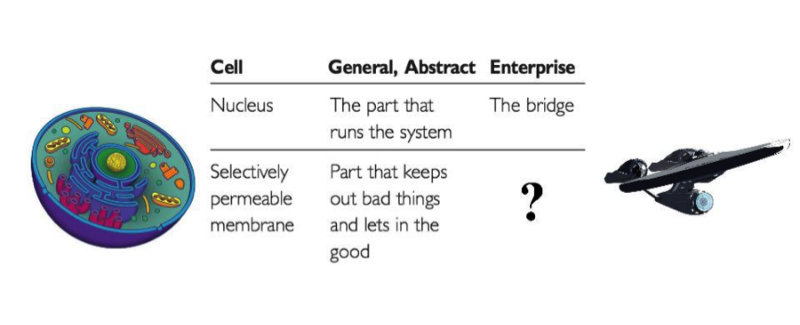 Some of the most common answers that students came up with were either… (a) the ship’s shield or (b) the transporter room. We then worked through the other parts of the cell to make connections between the cellular components and the USS Enterprise.
When we use analogies, the success of the activity depends largely on students’ ability to make connections to existing knowledge, so it’s imperative that educators make use of comparisons to things that students are already familiar with.
Fortunately, for teachers who struggle to come up with a great analogy, there’s a site called Metamia where teachers can find and share analogies used by other educators to explain a difficult subject or topic to their students.
 Metamia is a simple, great resource to help design activities that ensure our students develop meaningful, lasting connections about what is being learned.
Invite Students to Create and Explain Their Own Analogies
While teacher-directed comparisons are effective, students should also be asked to create and explain their own analogies. Doing so helps students to deepen their understanding and think about content in new ways, and sometimes helps disclose errors or missing elements in student understanding (Marzano, 2010).
For example, if a class were studying the brain and nervous system, students could be challenged to work individually or in groups to create analogies for each of the different components. For an activity like this, I like to use Google Slides.
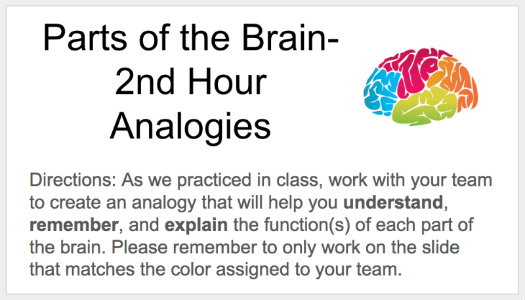
In each class, I create a set of color-coded class slides that includes the directions and an assigned slide for each group to work on. Unlike PowerPoint, Google Slides automatically saves any edits or changes that are made and permits multiple people to work on the same slide simultaneously. It provides a link that can be shared with students and also allows the teacher to quickly turn on or off students’ ability to edit the slides.
My students really enjoy being able to work collaboratively on a single slide – and also the chance to ‘peek’ at what their classmates are doing.
After each group has created an analogy for each part of the brain, they take turns explaining their thinking to another group or to the rest of the class. As they present, classmates are able to follow along on the slides. Afterwards, students are asked to privately evaluate and rank the effectiveness of the analogies presented by their classmates.
Finally, I ask students to identify the analogies shared by their classmates that helped them to best understand what was being taught. Students then use a simple tool like Piktochart or Easelly to create an infographic, or a chart that combines their analogies with other verbal and visual information on each component of the brain and its function.
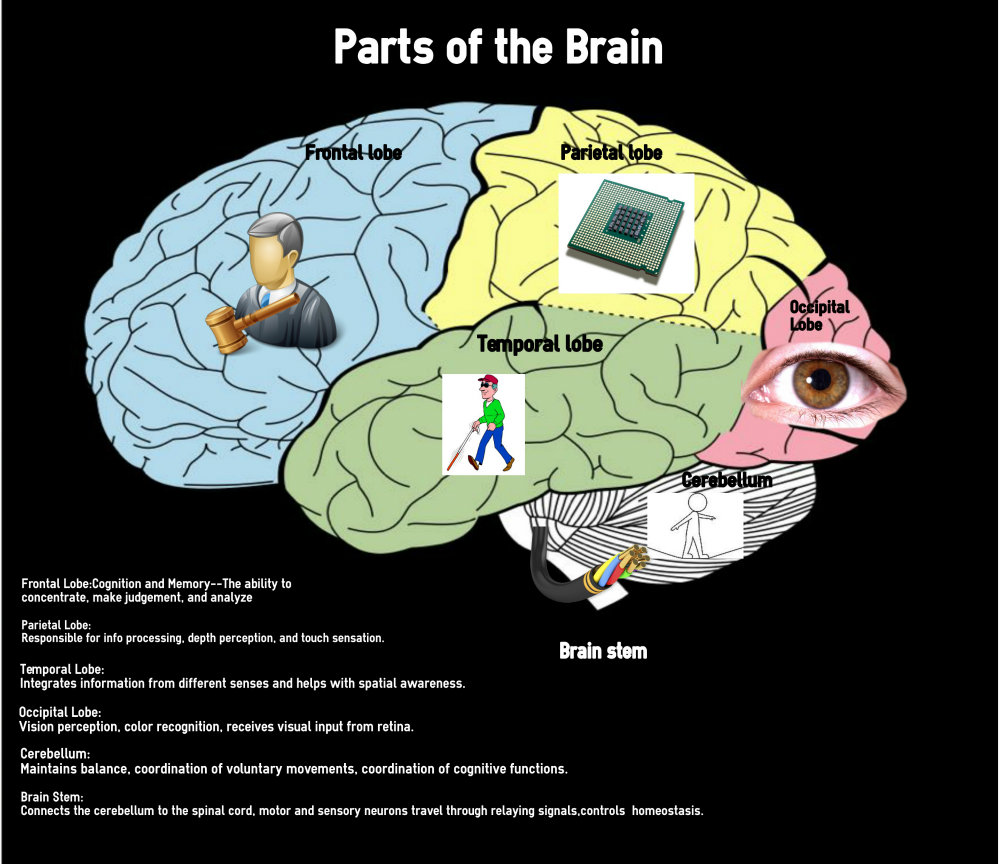
Click to enlarge.
Deeper, Long-lasting Learning
As a teacher, I find few experiences are more frustrating than spending a large chunk of time trying to teach new concepts to students only to discover that our students are struggling to understand (or that they have grasped a concept but it somehow leaked out of their brain overnight). By inviting our students to create and explain analogies, they engage in deeper, long-lasting learning.
Our middle school students spend plenty of time listening in class—probably too much. What they need are more opportunities to make comparisons, to make connections, and to explain their thinking. With the right analogy and a few tech tools, perhaps we can help them do just that.
References
Marzano, R. J. (2010). Representing knowledge nonlinguistically. Educational Leadership, 67(8), 84-86.
Marzano, R. J., Pickering, D., & Pollock, J. E. (2001). Classroom instruction that works: Research-based strategies for increasing student achievement. ASCD.
Siegel, Daniel J. The developing mind: How relationships and the brain interact to shape who we are. Guilford Publications, 2015.
ALSO: Read a MiddleWeb review of Rick Wormeli’s Metaphors & Analogies: Power Tools for Teaching Any Subject.