Building a Common Core-Based Curriculum
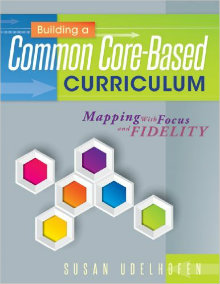
Building a Common Core-Based Curriculum: Mapping with Focus and Fidelity
By Susan Udelhofen
(Solution Tree Press, 2014 – Learn more)
 Reviewed by Kathy Foster
Education is a complex, symbiotic business. The many tenets need nurturing and support. One of the most important areas in any educational system is its curriculum. Curriculum is fluid, often changing from the highest level (government) and trickling down to individual schools.
In our district curriculum is constantly being revised to meet the needs of students. We use a Common Core-Based Curriculum, hence my interest in the book Building a Common Core-Based Curriculum.
 Building a useable curriculum is a process, a process that must include the input of the users: teachers. The author makes this point early in the book and continues throughout to emphasize this very important point.
This publication is very valuable and useful for identifying the steps in the process of curriculum building. Each step is outlined in sufficient detail to provide clear and explicit direction for implementation steps to take at each stage. Graphics are inserted appropriately so the reader does not have to flip and flop to find the graphic associated with the text.
The entire process is laid out linearly, step by step. I suggest the text be read cover-to-cover first, then readers can return to each individual chapter for implementation. In support of the text, a web site of electronic, printable reproducibles is available at no additional charge.
I highly recommend this publication to any district seeking to develop, review, or enhance its curriculum. The book is also valuable to teachers looking for ways to further develop their individual planning processes.
 Kathy Foster is an ELA Teacher/Coach who teaches 7th and 8th grades in a high poverty/high performing school in the Jennings School District, near St. Louis, MO. She has served students in high poverty districts for the past 24 years and loves teaching in urban schools. She was selected as the 2015 Teacher of the Year in her district and recently presented at two conferences: Mastery Connect and Chattanooga 2.0.
She writes: “The fantastic district in which I teach is 99% African American and 100% free/reduced lunch. The median household income is approximately $29,000. These data create a picture of an area in distress, and in a lot of ways it is. However, there is a brightly burning beacon of light: Jennings School District. A district faced with high poverty, and is high performing. We started from the bottom (partially accredited), and now we’re here (fully accredited) and our next target in Accreditation with Distinction. Our message to other districts with like demographics is this: It is possible. Slow and steady wins the race.”