PBL Gold: Deciding What’s Appropriate AND Important
A MiddleWeb Blog
 Alex T. Valencic is an avid reader whose “TBR” pile is more of a shelf stuffed with books. As a former fourth grade teacher and now a curriculum coordinator for 21st century teaching and learning, he has merged his love for reading with his love for innovation in education through this series. Here is his second blog post about the 21st century teaching and learning practices he promotes and supports in his district that have been influenced and shaped by the books he is reading.
Project-based learning (PBL) is not new to education; in fact, it has been argued that Aristotle and Confucius used project-based learning in how they taught.
In our era, PBL has had a major resurgence as schools and districts have looked for innovative ways to help students develop skills critical to success in the 21st century, such as creativity, communication, collaboration, and critical thinking.
Much has been written about project-based learning in the past decade. (For example, see these eight books that have been reviewed on MiddleWeb.) Some of these books focus on the logistics of planning and implementing PBL. Some focus on the nuts and bolts of what PBL really is. Some focus on how to do PBL within a specific content area while others present broad practices that work in any setting.
Over the last three years, I have read dozens of PBL books, attending half as many workshops, and watched more webinars and conference sessions than I can count. There are many questions that are asked and answered in all of these professional learning contexts, but there is a key question that I have only come across once:
Are there learning experiences that should not be given to students in a PBL setting?
Suzie Boss and John Larmer addressed this question in their 2018 ASCD book, Project Based Teaching, which was reviewed in some detail by Jeny Randall here. Boss and Larmer encourage teachers to consider two questions when deciding whether or not to use project-based learning:
- Is it important to learning?
- Is it appropriate for a project?
Reading these two questions was a lightbulb moment for me. In my current role as the curriculum coordinator for 21st century teaching and learning in my district, one of my responsibilities is to champion the use of project-based learning. Asking these two questions will allow me to help the teachers I support consider when to actually use PBL.
What Is Important and Appropriate Enough?
I would recommend every teacher interested in using PBL, whether for the first time or the 40th time, ask themselves these two questions before planning, launching, and implementing a new project.
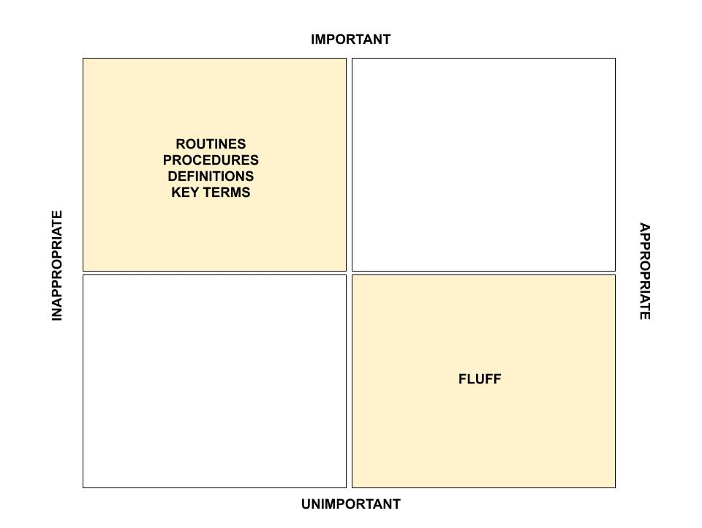
If we were to place the two questions on intersecting axes, we get a chart that looks like this:
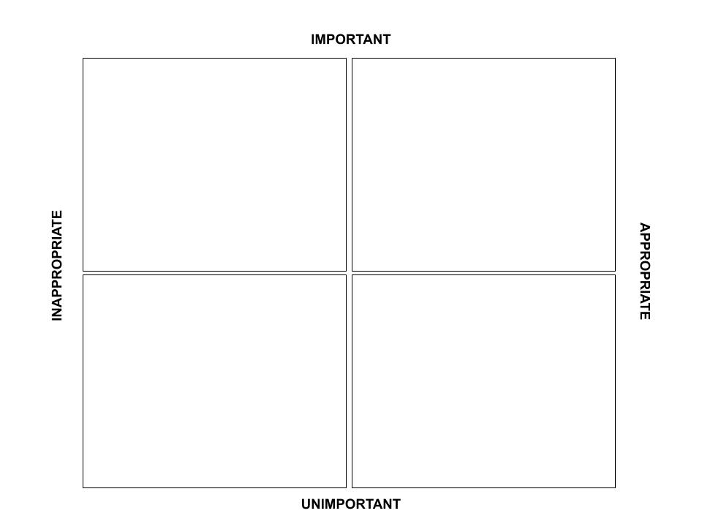 Let’s look at each quadrant, starting with the top left: important for learning but inappropriate for a project. This may include things like lab safety in a science classroom, classroom expectations, or definitions of key vocabulary words. Yes, you could use a PBL approach for this kind of learning, but it would not be the best use of time because this is the kind of learning that does not lend itself to sustained inquiry.
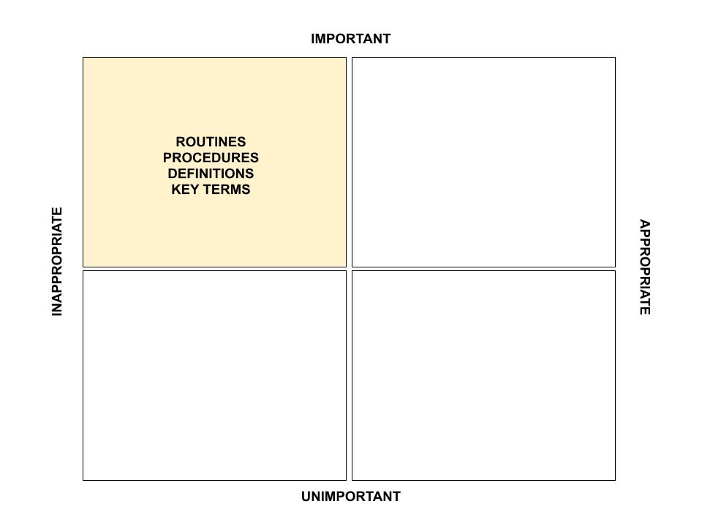 Opposite of the top left is the bottom right, where we find activities that are appropriate for a project but the concepts or skills are unimportant. This kind of learning can be thought of as fluff. It is fun, it is superficially engaging, but it doesn’t add much value.
The activities in this quadrant may include “craft” projects in which every student does the same thing in the same way, but not to develop a crucial skill. While there may be times to do a fluff project, such as a class party or the day before a term break, teachers are cautioned to limit how often they do these kinds of projects.
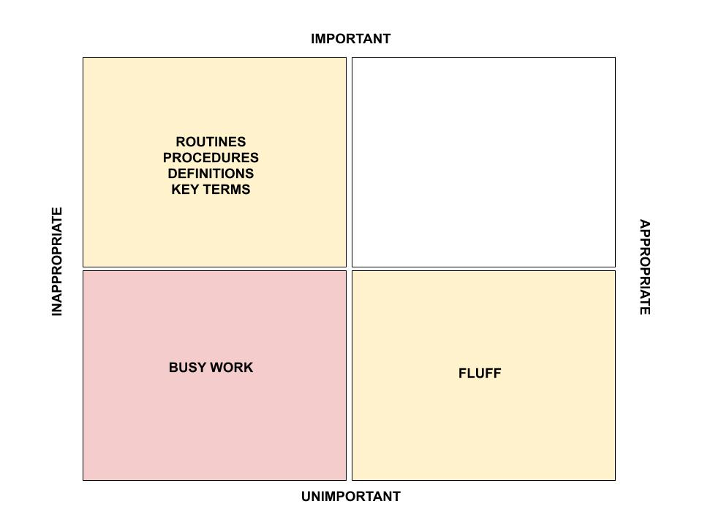
 The bottom left quadrant is the one that I hope teachers everywhere will seriously consider abandoning altogether. This quadrant contains busy work, often in the form of worksheets that do not aid in student learning. Busy work may include crossword puzzles or word searches that have students writing or finding vocabulary words but not using them in a way that transfers knowledge in a meaningful way.
 The last quadrant is, of course, the combination of concepts or skills that are important for learning and appropriate to a project. This is where high-quality project-based learning resides. (It should be noted that different organizations use different names for this type of PBL. The Buck Institute for Education’s PBL Works uses the term “Gold Standard PBL;” the Project-Based Learning Network uses the term “high performance PBL.”)
High-quality project-based learning is rooted in knowledge and skills that students will be able to use across multiple contexts and are best learned through sustained inquiry.
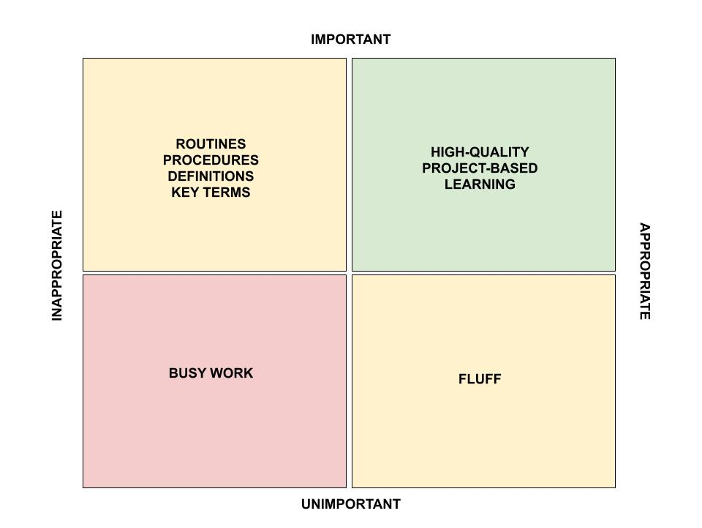 As can be seen from the completed diagram, asking yourself whether what you are requiring students to do is important for learning and appropriate for a project can help you identify whether you are engaging them in a task that is going to be most effectively done through the lens of project-based learning.
Even in a school that is “wall to wall PBL,” there are tasks that do not need to be taught through a project. Knowing when to deploy a project will assist you in knowing when to invest the time and effort to develop a high-quality project-based learning experience.