Arts Integration: Catch the Thrill!
A MiddleWeb Resource Roundup
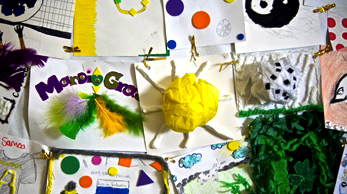
Beyond engagement and retention, adults and students at Bates [Middle School] cite numerous other benefits of arts integration: It encourages healthy risk taking, helps kids recognize new skills in themselves and others, provides a way to differentiate instruction, builds collaboration among both students and teachers, bridges differences, and draws in parents and the community. Plus it’s just plain fun.” ~ Mariko Nobori writing in an Edutopia Schools That Work series
 With such great outcomes, why isn’t everyone integrating the arts into core curriculum? And just what does it mean to do that?
The Kennedy Center for the Arts provides an in-depth look at arts integration at its ArtsEdge site, pointing out that the term goes beyond arts classes and enhancements in other courses to a full partnership. After careful deliberation, the Kennedy Center crafted this definition:
“Arts Integration is an APPROACH to TEACHING. Students Construct and Demonstrate UNDERSTANDING Through an ART FORM. Students Engage in a CREATIVE PROCESS Which CONNECTS an art form and Another Subject Area and meets EVOLVING OBJECTIVES in both.”
To see examples of arts integration in practice across language arts, science, social studies and math, explore the videos at the ArtsEdge page Arts Integration in Practice.
Jane Remer, a long-time educator and consultant with many clients including the Kennedy Center, advocates “all the arts for all the children, K-12.” In an article for ASCD, “Creating Rigorous Arts Lessons Across the Content Areas: Tips for Collaboration,” Remer reviews several large-scale projects and then goes on to outline how classroom educators can integrate arts into their classes, in part through consultation with arts educators. Her closing paragraphs offer guidelines for day-to-day success.
In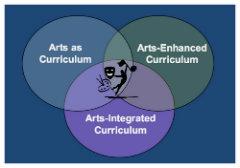 an ASCD Educational Leadership article, “The Arts Make a Difference,” Nick Rabkin and Robin Redmond, authors of 2012’s Putting the Arts in the Picture: Reframing Education in the 21st Century, describe the elements that make arts integration in a school or district work. These elements include accessing local arts resources; promoting collaboration among content educators, arts educators and artists; and using the arts to build “careful observation, inquiry, practice, creation, representation, performance, critique, and reflection.” Rabkin and Redmond note the challenges arts integrators face: “Arts integration is not simple or easy work. The educators and artists who have developed it have worked with meager resources and have swum against a tide of stereotypes that keep the arts in the margin, despite their demonstrable and dramatic success in raising student achievement.”
Arts integrators “have swum against a tide of stereotypes that keep the arts in the margin, despite their demonstrable and dramatic success in raising student achievement.”
 To find out what arts integration looks like at a middle school, visit Edutopia’s Schools That Work video on Bates Middle School in Annapolis, MD. At Bates, Vanessa Vega writes, “Job-embedded professional development, differentiated arts instruction, and critical-thinking skills integrated into the curricula have been key to [the students’] success.” Vega notes that “What makes arts-integration practices particularly effective at Bates Middle School is the fact that Bates teachers design arts-integrated activities to address the specific standards that students are having the most trouble understanding.”
As Vega points out, the efforts at Bates are based in part on the principles of Harvard’s Project Zero and its Artful Thinking project (here with an updated link). The Artful Thinking site is loaded with resources for the classroom, including wide ranging curriculum connections and links to images, museums and more.
Edutopia also provides links to fully developed lesson plans in several content areas for grades 6, 7 and 8, as well as professional development resources used in Anne Arundel County public schools and templates used at Bates. And if you’re a visual learner (smile) check out Edutopia’s Pinterest page on arts integration. Find more arts integration resources from Edutopia at Andrew Miller’s blog on integrating arts into project based learning.
With Connecting with the Arts, Annenberg Learner provides a series of video workshops for middle grades teachers. Watch to see teachers talk about arts integration and its value to students, strategies for collaborating with other educators, roles students adopt as part of AI, ways to connect across the curriculum, evaluation of learning, and more. The free workshop series is a companion to Annenberg’s collection of 12 Connecting with the Arts videos of visits to AI classrooms which can be purchased.
How relevant is arts integration, really?
In “The Social and Emotional Benefits of Being Weirdly Creative,” Edutopia editorial director David Markus quotes a Bates student: “At first you feel pretty weird, especially singing and dancing.… You think maybe someone will make fun of you. But because everybody has to sing and dance and do the art, everyone is in the same boat… (My source seems to relish this next part of his description.) So you have to keep doing the art day after day. You have to dance the motions of the planets or sing their name in a song or take a photo of a jungle gym exhibiting the properties of an isosceles triangle. And somehow, through all these awkward displays of creativity, the social playing field levels, and you actually start to have fun, and you begin to make friends with kids you might never have even spoken to, because they’re having fun, too.”
More insight about the potential impact of arts integration on schools, students and families can be found in the documentary video School Play, reviewed in this MiddleWeb article, “The Creative Lives of Children,” by K-6 principal Lyn Hilt. You can watch a trailer for the award-winning film at YouTube.
 In a guest post at MiddleWeb’s STEM Imagineering blog, educator Sammy Parker writes about the impact of the arts on STEM courses, noting, “From the lives and words of Nobel laureates to the eye-opening changes that the arts have on students, especially low-SES ones, to the dynamism and success of classrooms and other educational settings that meld the best of both worlds, the evidence for the immense value of creating and cultivating a nexus of the arts and STEM is persuasive.” He goes on to suggest ways teachers can work together to bring that intersection to their students.
For educators who wonder how implementing the Common Core State Standards might relate to (and impact) arts integration, McREL’s Kirsten Miller provides some possibilities in “Common Core Quick-Start: How the Arts Intersect with the Common Core State Standards,” included in the recent ASCD Express issue, Thoughtful Arts Integration.
You’ll also find a detailed examination at The Arts and the Common Core: A Review of Connections Between the Common Core State Standards and the National Core Arts Standards Conceptual Framework. The document was prepared by the College Board for the National Coalition for Core Arts Standards in 2012. This coalition of arts education organizations plans to complete its re-imagining of national arts standards during 2013.
Update: Writing at Edutopia, Elena Aguilar suggests ways to integrate the arts into the post-test weeks to bring enthusiasm back into the classroom. (May 2013)
Image credits
Frontpage: STARSFoundation via Compfight (Creative Commons)
Art Display: Bates Middle School via Edutopia
Venn Diagram: ArtsEdge, Kennedy Center for the Arts
Children at wall: Santa Catalina School via Compfight (Creative Commons)