Class Fiction: History+Mystery!
Elizabeth Varadan is a YA fiction author and a former middle grades teacher in Sacramento, California. While teaching, she integrated her lesson plans across the curriculum as much as possible. Art and reading (novels, mysteries, and biographies) related to class history lessons. Her own love of history began at an early age with historical fiction and mysteries.
Elizabeth now teaches an after-school art class for 8-to-12-year-olds at a local community center, and blogs about the Victorian Era. At her second blog, she writes about her travels with her husband, children’s fiction, and other topics that interest her. She’s currently writing an historical mystery for tweens.
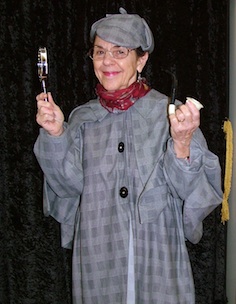
Elizabeth Varadon
Why Middle Grade Teachers Need Historical Mysteries in the Classroom Library
by Elizabeth Varadan
When I was teaching sixth grade, I stocked my classroom library with historical mysteries students could read for pleasure and use for hands-on projects to make history more meaningful.
While historical fiction helps a reader of any age access the past, a middle grade historical mystery provides an even greater hook.
Why a Historical Mystery?
A historical mystery presents an irresistible question that a reader wants answered. In Avi’s The Cross of Lead, set in 14th century England, a 13-year-old boy known as “Asta’s son” has to flee his village because of a crime he didn’t commit. In the course of his adventures, he learns his true name is Crispin. The mystery of why Crispin has enemies in pursuit and who his father was drives the twists and turns of the story.
In Rebecca Stead’s When You Reach Me, Miranda, a latchkey kid in New York of the 1970s, must figure out who broke into the apartment and stole the spare key and who is sending her mysterious notes, one of which suggests she can prevent a death. But whose?
 A favorite of my sixth graders in Sacramento was Dragonwings by Laurence Yep, one of the many novels in the Golden Mountain Chronicles, coming-of-age stories about a Chinese family who survives the 1906 San Francisco earthquake. Hooked on the classroom set of Yep’s Chinatown Mysteries series, my students also read for pleasure The Case of the Goblin Pearls (12-year-old Lily and her Auntie Tiger Lil, a former film star, must discover who stole the pearls in question); The Case of the Lion Dance (they must find out who set off a bomb); and The Case of the Firecrackers (they must puzzle out how a loaded gun got onto the set of a TV show).
Our school had a culturally diverse population. These novels provided rich details about Chinese history and traditions that all students found interesting as well as entertaining mysteries. Since one of our social studies strands was on Ancient China, we followed up with a kite-flying contest using student-made kites, and we made paper and used bamboo brushes to paint pictures.
Luring the reluctant reader
 While improving reading comprehension skills, a reluctant reader of historical mystery discovers the pleasure of reading and that history can be interesting, both of which are bound to make a difference in future scholastic endeavors and writing. It might be tempting to point poor readers to easy-to-read novels, but a well-written classic has the power to spark interest.
The Golden Goblet, by Eloise Jarvis McGraw, is a good example. Ranofer discovers his half-brother is robbing tombs—a crime punishable by death. Somehow he has to stop this without endangering or incriminating himself. My students stumbled through the geography and cultural practices of ancient Egypt, as well as complicated names, to find out if Ranofer would succeed, all because the story lured them on. Mara, Daughter of the Nile, also by Eloise Jarvis McGraw, and His Majesty, Queen Hapshetsut, by Dorothy Sharp Carter, provided intrigue and further information for class projects, in which students made pyramids with cut-away sections to reveal hieroglyphic wall paintings, tiny mummies and artifacts for the afterlife.
Victorian mysteries for the middle grades
 In the United States, social studies subjects in the early middle grades are typically state and local history for fourth grade, early Americas and their interaction with England and Europe for fifth grade, and ancient world cultures for sixth grade.
But Victorian era fiction — with vivid British characters and stories that fuel young readers’ imaginations — is a wonderful category for upper elementary and middle school classroom libraries. During this era the telegraph, telephone, electricity, indoor plumbing, and motorized vehicles were developed—inventions that transformed the world as dramatically as the space probes and the Internet are transforming our planet today.
 Social movements were developing to protect children, procure women’s right to vote, and honor cultural diversity — all rights we take for granted today. As the backdrop to world events of the 20th century, the Victorian era helps frame the lives of our recent ancestors and ourselves.
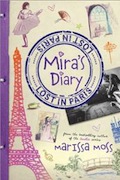
Marissa Moss’s brilliant new series, Mira’s Diary, featuring time-travel mysteries in various historical periods, begins with Lost In Paris, in which Mira encounters famous painters in 1880s France and finds she has a role to play in the famous Dreyfus Affair.
In Lewis Buzbee’s award-winning Victorian mystery, The Haunting of Charles Dickens, 13-year-old Meg Pickel and her friend, Charles Dickens, go sleuthing for her missing brother and uncover a kidnapping gang—not an unusual occurrence in an era when children had few rights.
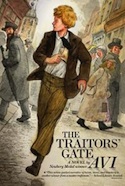 In Avi’s The Traitor’s Gate, set in the London of 1849 and illustrating several social issues of the time, the father of 14-year-old John Huffam is threatened with debtors’ prison for owing money to a man he claims he doesn’t know. (For any of these novels, students could, for extra credit, write a story of their own, using details they’ve learned about Victorian England. Or they could be newspaper reporters for one of the newspapers of the era and report on the situation.)
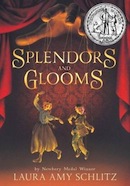
In Laura Amy Schlitz’s Victorian fantasy, Splendors and Glooms, set in 1860 London, 12-year-old Clara disappears the night of her birthday. The two orphans who help the novel’s puppet master learn that other children have mysteriously disappeared after his shows and that it’s up to them to rescue Clara. (A good follow-up project would be to put on a puppet show with scenes from the book.)
All of these books bring to life a world where most travel was horse-drawn, where communication was by post, where electricity was only for the rich, where children could be pressed into work gangs, and where single women could not venture out of their homes alone—a world where even the nobility would envy any one of the things we take for granted today.
Rich in mystery as well as history, they appeal to students’ love of adventure, puzzles, and strange locales — and most of all, to their unending curiosity about what life was like for children their own age long ago.