
How to Energize a Weak STEM Lesson
A MiddleWeb Blog
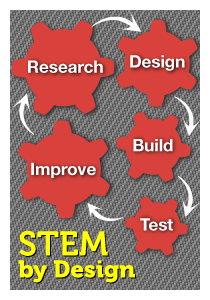 A recent EdWeek article by Jan Morrison & Buzz Bartlett (leaders at the Teaching Institute for Excellence in STEM) underscores the importance of access to STEM education for all students in our schools. As they point out, STEM knowledge and skills can help assure that future graduates will have productive work in the decades to come. They write:
…While some may question current workforce needs for highly trained people in these fields, no one doubts that an education in STEM subjects is the ticket to a decent-wage-paying career in the economy of the 21st century.
Because of this economic reality, access to a high-quality STEM education is no longer simply an academic issue, but a matter of equity as well.
We must offer all of our students the opportunity to graduate with STEM skills. And whether or not they develop those skills depends in part on how they respond to the STEM curriculum – to the quality of the lessons we teach.
We need high quality STEM lessons
When schools offer a STEM program, curriculum is critical. It’s not science, it’s not math, it’s STEM. And the lessons need to be shaped by STEM principles and criteria.
Most kids like solving problems, and this is a real plus for designing STEM lessons that appeal to all students. If they can apply what they learn in science and math (using the engineering design process) to come up with viable solutions to vexing problems, think what reality and purpose that can bring to their learning.
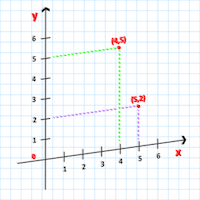 Let’s suppose your students have been learning about energy and force in science, and about measurement and Cartesian graphs in math. Now you need a STEM lesson that will let them apply what they are learning to solve a problem. Off you go to some websites that claim to offer STEM lessons. You find a possible lesson but wonder, “Is this really a STEM lesson, or is it just a great science experiment?”
This brings up two questions:
(1) What are some good sources of STEM lessons?
(2) How can you recognize and adapt a STEM lesson you might acquire from a book or an online source?
Sources for STEM lessons
 When choosing lesson plans, remember that STEM lessons focus on the designed world. For example, we design solutions to lessen threats to life. We design solutions to minimize damage to the environment. We design things to ease the amount of work necessary to accomplish something.
The world we live in has been shaped in many important ways by people who have engineered solutions, largely through technology, to meet needs. In a sense, then, STEM curriculum will focus on designing and creating.
The Next Generation Science Standards shed light on this. They focus both on how the natural world works, and how the natural world interfaces with the designed world. These standards present engineering education and science education as equals. They emphasize a key set of scientific and engineering practices, along with cross-cutting concepts that help to integrate science, math, and engineering. If you are teaching within the NGSS guidelines, then some of your current lessons probably meet the definition of STEM lessons.
As an FYI, the Common Core State Standards for Mathematics (CCSSM) point out science and engineering practices that need to be combined with specific math/statistics practices. So if these two initiatives (NGSS and CCSSM) are in place, you already have a start on locating STEM curriculum.
 Additional sources claiming to offer STEM lessons plans populate the Internet. Just type “STEM lessons” into a search engine and a big crowd will appear on your screen. The problem is, a lot of these are not actually STEM lessons. They are science lessons, math lessons, engineering lessons, etc. You will need to modify most of these to make them authentic integrated STEM lessons. I’ve listed a few sources below.
- iSTEM Documents for Engineering Challenges (24 middle level STEM lessons. Click on folders.)
- PBS KIDS’ Design Squad Nation
- PBS Teachers STEM Education Resource Center
- EPA Teacher Resources and Lesson Plans
- eGFI – for Teachers>>Lesson Plans
- WeAreTeachers Pinterest sites
- BrainPOP Spotlight STEM (Be choosy)
Recognizing and adapting a STEM lesson
As you look through lessons labeled “STEM,” you may want to use this list of STEM Lesson Criteria to see how close they come to the real thing. STEM lessons should include most, if not all, of these.
STEM Lesson Criteria
- Presents a real and compelling problem
- Students can relate to the problem
- Integrates and applies science and math grade-level objectives
- Includes the engineering design process as a method for solving problems
- Uses an inquiry-based, hands-on teaching and learning approach
- Allows for multiple acceptable solutions
- Encourages creativity and innovation
- Leads to the design and creation of a product
- Involves testing the product and evaluating the results
- Requires students to work in teams
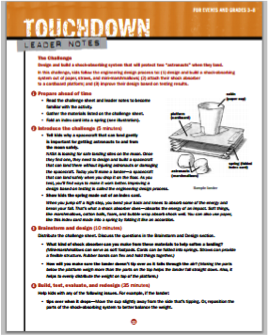 Now let’s try using this list to check out an online lesson. Click on this lesson titled Touchdown from the PBS Kids Design Squad. Spend a few minutes reviewing the 4-page description. Then, evaluate the lesson according to the STEM Lesson Selection Criteria.
Here’s my take on this lesson:
For Criteria 1 and 2, I give it a thumbs up. The problem is real, compelling, and kids can relate to it.
For Criteria 3: Does it integrate and apply science and math grade-level objectives? I have some hesitation. Although some curriculum connections are at the end of the lesson, they are not made explicit to the students as the lesson is conducted. If you want to use this activity, first make sure it matches your science objectives (perhaps force and motion, energy, Newton’s Laws). Also make sure the math objectives are included (perhaps measurement, scatter plots, Cartesian graphing, etc.)
Teach the relevant science and math prior to using this activity, and include them pointedly during the activity. (Note: some teachers use the STEM activity to teach the objectives. That might work – or not – depending on the time it takes. STEM activities typically are used as reinforcers.) To strengthen the curriculum connections in the STEM lesson, science and math teachers would ideally work together.
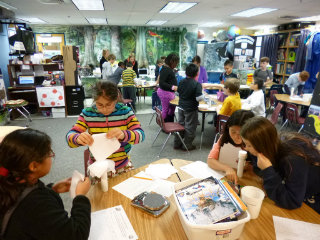 For Criteria 4 – 9, I’d give a thumbs up. One thing I’d be sure to do, however, is avoid giving students the information about how the materials might be used to create shock absorbers. Make them think! I’d simply give teams the materials and let the team members muck about with them to invent ways to use them as shock-absorbers. I would not fold an index card into a spring to show kids how to make a shock absorber, for example. If a team is completely stuck or off track, you may need to give them some hints and idea starters, of course.
As for Criteria 10, the students are never directed to work in teams. Definitely add this to the lesson plan.
Other considerations
In your discussion with kids, be sure to elicit student knowledge about the math and science used in this experiment. You might have teams make a graph of the relationship between the height from which their lander fell and its success in preventing the astronauts from falling out. Or they might graph one of the two extended challenges.
Notice that this is designed as a 60 minute lesson. That may be unrealistic, given the time kids will need to create designs, test them, discuss, do the graphing, and nail down the connections with the science and math content. I’d plan for a two-day lesson. You might even coordinate with the technology teacher to locate apps to reinforce the science and math objectives and let students experience them.
I’d definitely rate this lesson as a “keeper” with several modifications to tailor it for your students and your STEM needs.
See two other lessons that Anne tests against her criteria.
What lessons have you come across that work well for you? What lessons do you need to locate? I truly hope that if you have some good sites to share, you will do so in the Comments.






I recently discovered a wonderful source of K-12 STEM curriculum for the classroom – Code RED Education. Used by several school districts here in St. Louis area. More info can be found at coderededucation.com .