Mastering Test Anxiety: Student & Teacher Tips
 By Curtis Chandler
For most people, spring is a time of renewal, warmth, and hope…especially after a long, cold winter. But for many educators, spring marks the arrival of something else…the sprouting of something noxious and foreboding. In schools around the country, it’s the season of assessment and anxiety.
Debilitating Anxiety
Whether we are talking about students, teachers or anyone else, excessive anxiety and fear can have a debilitating effect on us. I know this firsthand, because I am terrified of heights. Not just scared in a normal, safe way but completely and utterly petrified by bridges, tall buildings, flying, and just about anything that puts me more than a few feet above the ground.
 As a result, I have missed out on some potentially amazing experiences. For example, I occasionally brag about having visited the Eiffel Tower, but fail to mention that I never even made it up the first flight of stairs.
A while back, my family and I drove to Yellowstone Falls, but the view from the parking lot gave me vertigo so badly that I never made it out of the car. My five-year-old said that the hike and lookout over the falls were breathtaking. I ended up just having to take his word for it.
In the classroom, excessive anxiety is likely to interfere with the learning of students and the effectiveness of teachers. Test anxiety reduces students’ concentration, memory, processing, recall of information, and overall performance on assessments (Szafranski, Barrera, & Norton, 2012).
Equally concerning are its effects on educators. Teachers regularly report changing their instructional practices because of increasing concern about student performance on tests (Saeki, Pendergast, Segool, & von der Embse, 2015). These changes often include narrowed curriculum and increased use of counter-productive teaching methods (Nathaniel, Schultz, & Draughn, 2015).
Facilitating Anxiety
 Not all anxiety is bad, however. In fact, a small amount of worrying actually improves performance by spurring learners—and the rest of us—into action. Consider, if you will, the circumstances surrounding my upcoming 20-year class reunion. For years I have talked about eating healthier, exercising more, and buying something snazzy to wear to replace the 90’s Zoot suit still hanging in my closet. Yet, it has been the impending reality of rubbing shoulders with my old classmates that has finally coerced me into do anything about it.
I realize that, in an ideal world, we would all learn for the sake of learning, study topics deeply without tests, and work to complete something meaningful without established criteria or due dates. But for most people, it’s the worry that gets us working. The key is to keep teachers’ and students’ anxiety levels at a facilitative level, to take steps to ensure that neither teachers—nor their students—become overly anxious about assessments.
Tips for Keeping Student Anxiety at Bay
Much of reducing student test anxiety seems to have little at all to do with the assessments themselves. For example, student-teacher relationships and classroom environment can greatly enhance student resilience, motivation, and in result, improved overall academic test performance (den Brok, Brekelmans, & Wubbels, 2004).
But even in the most encouraging of classrooms, student anxiety still surfaces from either (a) not knowing what a test will be like; or (b) having been unsuccessful on similar tasks in the past. Keeping students’ anxiety at bay, therefore, requires educators to address both these factors.
 Teachers must work strategically to take the ‘pop’ out of ‘pop quiz’ by providing students considerable guidance about the format, duration, and content of exams. Students perform better when they know what to expect and have multiple opportunities to develop all the knowledge and skills necessary to be successful.
This requires teachers to be as familiar as they can be with high-stakes tests, schedule time for practice assessments, and provide students with specific, formative feedback rather than global evaluations of how they did.
Equally important is the need to explain the purpose of an assessment. After all, students are more likely to be motivated and successful when they understand the value of education tasks (Martin, 2001).
It should come as no surprise that one of the biggest predictors of student achievement on exams and other learning tasks is whether or not students have been successful in the past (Hattie, 2012). As a result, assessments become a sort of self-fulfilling prophecy: students who tend to do well on tests expect to do well, while those who struggle are likely to continue to do so.
For teachers, this means designing and scaffolding test-like opportunities that help students be successful. It also means working to build students’ self-efficacy through clear, concrete, and realistic expectations for performance. When teachers help students to set (and reach) learning goals, students are more likely to experience success on their own terms, regardless their overall grade or the performance of their classmates (Ormrod, 2014).
Reeling in Teacher Assessment Anxiety
Students aren’t the only ones who get worked up about high-stakes assessments. Educators are under increasing pressure to raise student test performance and are often just as likely to develop unhealthy levels of anxiety in the weeks leading up to the big test. How teachers manage stress and anxiety has important implications for students in the classroom.
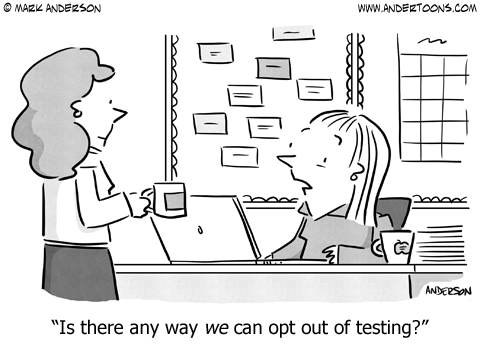 I have observed, coached, and co-taught in the classrooms of a number of educators known for low-stress success on high-stakes exams. They all insist that ‘preparation is power.’ By that, they mean that no matter how busy they get as teachers, they consistently make time to work with their colleagues to explore the in’s and out’s of the standards and assessments in their state. Compared to other teachers, they are less anxious come test day because they have spent time unpacking the content, skills, and vocabulary likely to surface on exams.
One successful, lower-anxiety teacher recently commented to me that high-stakes tests should be like showing up for a surprise party that someone throws for you that you already knew about. In other words, it’s a big day, you are excited to be part of it, but there are no real surprises.
High-stakes tests should be like showing up for a surprise party that someone throws for you that you already knew about.”
I find this perspective extremely helpful. In our classrooms, there should never be anything unexpected when it comes to student learning. It’s part of our job to monitor students’ current performance levels and to provide specific feedback about the content and skills they still need to develop.
We will be less anxious (and better prepared) when we are knowledgeable about student progress throughout the learning episode, and not just at the end of it. In other words, test-prepared classrooms spend less time worrying about the assessment, and instead, focus on instruction and learning.
Death, Taxes, and Test Anxiety
I was a child when I first heard that the only two certainties in life were death and taxes. In an era of standards, accountability, and high-stakes education, I would like to add testing and anxiety to the list. Both assessment and anxiety are here to stay. As educators, we must recognize this, work to keep the dosages small, and ensure that tests and anxiety help facilitate learning instead of inhibiting it.
References
Hattie, J. (2012). Visible learning for teachers: Maximizing impact on learning. Routledge.
Martin, A. J. (2001). The Student Motivation Scale: A tool for measuring and enhancing motivation. Australian Journal of Guidance and Counselling, 11(1), 1-20.
Ormrod, J. E. (2014). Educational psychology: Developing learners. Pearson.
Szafranski, D. D., Barrera, T. L., & Norton, P. J. (2012). Test anxiety inventory: 30 years later. Anxiety, Stress & Coping, 25(6), 667-677.
Nathaniel, P., Schultz, B. K., & Draughn, J. D. (2015). Readying students to test: The influence of fear and efficacy appeals on anxiety and test performance. School Psychology International, 36(6), 620-637.
Dr. Curtis Chandler (@CurtisChandler6) is an education professor at Brigham Young University-Idaho in Rexburg. Curtis has been a Kansas Teacher of the Year and a KS regional instructional tech coach. “I am a middle school teacher through and through,” he says. He enjoys spending time with his wife and his favorite students – his four sons. His two blogs for MiddleWeb include Class Apps (insightful articles about blending tech and teaching strategies) and New Teacher Tips, a blog dedicated to preservice and beginning teachers. Browse our entire collection of Chandler articles here.
Image credits
Yellowstone Falls: By Rickymgb (Own work) [CC BY-SA 3.0 (http://creativecommons.org/licenses/by-sa/3.0)], via Wikimedia Commons