Try Nonfiction Graphic Novels to Engage Kids
By Kasey Short
 Over the past few years there have been many engaging and powerful nonfiction graphic texts published – memoir, history, civics, science – for adolescent readers.
It’s beneficial for students to be introduced to this type of reading. Many students are more eager to pick up a graphic novel or nonfiction book because they view it as being shorter and more “fun” to read.
I’ve found over the years that some students read all the words but skim or bypass the images entirely, much as they do with traditional nonfiction texts, ignoring images and graphic representations. Nonfiction presented in the style of “graphic novels” serves as a unique way to teach students the value of reading the images and combining what they learn through the words and pictures to develop a more complete understanding of the topic.
Graphic nonfiction also allows students to gain a depth of knowledge of a topic in a shorter time than a traditional book. Many graphic nonfiction books are memoirs that provide opportunities to understand others and develop empathy. Using graphic novels allows for students to potentially explore multiple memoirs and perspectives within the same time frame as they would when reading a traditional memoir.
Graphic nonfiction also helps disprove the idea that nonfiction is boring and encourages students to seek out other forms of nonfiction by creating curiosity around a particular time, person, and/or situation.
Suggested Questions for Nonfiction Graphic Novels
- How did the format of the book impact your experience as a reader? How would this book be different if it were written in a different format such as poetry, prose, or traditional textbook?
- What are some things that you learned from the images that you were not able to get from the words alone?
- Find a page or panel of the book that used images only and no words. Why do you think the author made that choice? What was the impact of that choice? If you were to insert words in that section, what would you include?
- What facts that you learned from the book stand out the most and/or surprised you the most?
- After reading the book, what do you still wonder about the topic? Where could you find additional information?
- What were you able to learn from facial expressions in the book? Find a few specific panels and use those to explain your answer.
- If given the opportunity, what would you want to ask the author and/or illustrator?
- Was the book written and illustrated by the same person or two different people? How might this impact the book?
- Examine the settling of the story. List different details you notice in the panels, provide information about the setting, and explain what you learn from those details.
- How did the images make you feel?
- How did the author use color or lack of color in the images to tell their story?
- How do you read a graphic novel? Do you read the words first and then examine the images, or examine the images and then read the words?
Middle Grade and Young Adult Recommendations
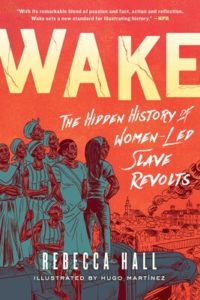 Wake: The Hidden History of Women-Led Slave Revolts by Rebecca Hall – This powerful graphic novel tells the story of Rebecca Hall’s experience researching slave revolts led by women and then working to share their untold story with others. It also showcases what she learned in her research as well as includes fiction to construct what might have happened to these women.
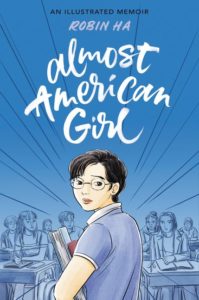 Almost American Girl: An Illustrated Memoir by Robin Ha – In this honest memoir, Robin tells her story of growing up in Korea and then unexpectedly finding herself living in Alabama with her new stepfamily. This memoir showcases her immigrant experience of being in a new place with a new language and discovering that creating comics is fun and allows her to express herself.
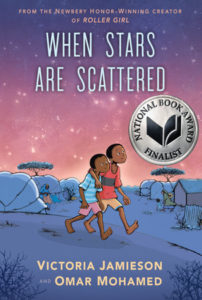 When the Stars are Scattered by Victoria Jamieson – This book uses vibrant and detailed illustrations to tell Omar’s story of growing up as a Somali refugee in a refugee camp. It details his experiences in the camp, the sacrifices he had to make to get an education, and the extended time he spent waiting for an opportunity to come to America. This book is heartbreaking while also leaving the reader with hope.
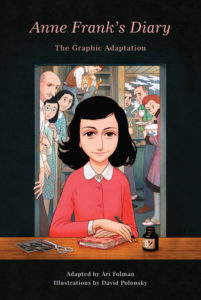 Anne Frank’s Diary: The Graphic Adaptation adapted by Air Folman – This book tells Anne Frank’s well-known story with beautiful artwork that captures the emotion of Anne’s story. The images in this book help readers visualize her living quarters in the annex. The author also includes some full diary entries that allow the reader to hear Anne’s voice from the diary.
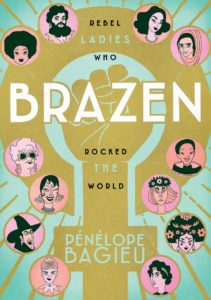 Brazen: Rebel Ladies Who Rocked the World by Penelope Bagieu – This beautifully illustrated graphic novel highlights women throughout history and across the globe who have rebelled against societies’ expectations of women and who inspire today’s youth with their “brazen” approach toward life.
 Wild Weather: Storms, Meteorology, and Climate by MK Reed and Jonathan Hill. One of a 30-book series of Science Comics from Macmillan. Each volume offers a complete introduction to a particular science topic; e.g., dinosaurs, coral reefs, the solar system, volcanoes, bats, flying machines, and more. Engaging art and storytelling.
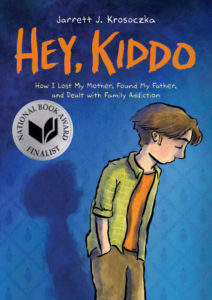 Hey Kiddo by Jarrett Krosoczka – This graphic memoir explores the author’s experience growing up with a mother who suffered from addiction, his having a complex family where he was raised mostly by his grandparents, and how important art was in his life.
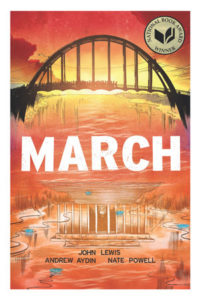 March Series by John Lewis – This powerful and important trilogy recounts John Lewis’s personal experiences fighting for civil rights and many important moments of the civil rights movement. The books include moments such as John Lewis meeting Dr. Martin Luther King Jr., his participating in nonviolent protest, and the 1963 March on Washington for Jobs and Freedom.
More Recommendations
• Smile by Raina Telgemeier
• Maus by Art Spiegelman
• Persepolis by Marjane Satrapi
• In the Shadow of the Fallen Towers: The Seconds, Minutes, Hours, Days, Weeks, Months, and Years after the 9/11 Attacks by Don Brown
• A-Okay by Jerad Greene
• Messy Roots: A Graphic Memoir of a Wuhanese-American by Laura Gao
• Welcome to the New World by Jake Halpern
• Borders by Tomas King
• Naturalist – A Graphic Adaptation by Edward O. Wilson
• Dare to Disappoint: Growing Up in Turkey by Ozge Samanci
• Grass by Keum Gendry-Kim
• I Was Their American Dream: A Graphic Memoir by Malaka Gharib
• Human Body Theater: A Nonfiction Review by Maris Wicks
• Open Borders: The Science and Ethics of Immigration by Bryan Caplan
• Escape from Syria by Samay Kullab
• They Called Us Enemy by George Takei
Kasey Short (@shortisweet3) is the Middle School Director of Studies and an 8th Grade English Teacher and Advisor at Charlotte (NC) Country Day School. Kasey loves to share ideas from her classroom and her leadership roles and writes frequently for MiddleWeb.
She attended the University of North Carolina at Chapel Hill where she earned a bachelor of arts in middle school education with a concentration in English and history. She went on to earn a master’s in curriculum and instruction from Winthrop University.
Browse all of Kasey’s MiddleWeb articles here and follow her at Bluesky.