STEM Class: Starfish or Spider?
A MiddleWeb Blog
If you like to read business/leadership books, you may have deduced that I just finished reading a thought-provoking book, The Starfish and the Spider: The Unstoppable Power of Leaderless Organizations, by Brafman and Beckstrom.
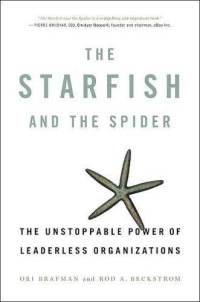 As any life science teacher can tell you, if you cut off the arm of a starfish, the creature will grow a new arm. In fact, in some starfish, the severed arm will grow a new body. A starfish doesn’t have a head because the nervous system is decentralized and each arm contains all the organs it needs to operate independently.
Spiders may look somewhat similar, but their nervous system is centralized. If you cut off a spider’s leg, you simply have a seven-legged spider. If you whack off its head, the spider dies.
The purpose of the book is to contrast decentralized organizations with organizations where power and control is concentrated in a central location or group. However, this idea intrigues me from a STEM education standpoint. As we increasingly implement STEM curriculum in our classrooms, how does that look? Does our approach use the starfish as a model? The spider? Or maybe a hybrid – something in between? And does it matter?
Consider these classrooms:
Classroom A. The teacher shows students a short video about a real life problem that catches their attention. She carefully explains the STEM problem for which the students need to find a solution. She then leads a group discussion and an activity, making sure students cover the content information they need for the project. The teacher places students in teams, assigns team roles, and gives teams guidelines or norms to guide behavior. She then gives each team a handout with directions for how to proceed as they work on finding a solution for the problem. She also shows teams what materials they will have to work with when they choose a solution and construct their prototypes. She circulates to provide advice and help as teams work.
Classroom B. The teacher shows students a short video about a real life problem that catches their attention. She then asks students to work in teams to articulate the problem. She checks for understanding, then turns teams loose to begin brainstorming multiple solutions. As they work she circulates and acts as a catalyst by asking questions as needed to help teams drive toward solutions, although she doesn’t step in to prevent them from making mistakes. Students identify information they need in order to better understand and solve the problem and the teacher provides resources to help students learn, including a wide variety of materials from which they might choose to construct a prototype. Team members decide what roles they need to play, make sure that everyone has a role, and set their own norms based on behaviors they like in other team members.
Classroom C. The teacher shows students a short video about a real life problem that catches their attention. He then asks students to work in teams to articulate the problem. To make sure students have the information they need to make decisions, he leads a group discussion and an activity. In order to spur ideas for solving the problem and help teams choose solutions, the teacher provides each team with a variety of materials. He then circulates and asks questions to help teams arrive at solutions as needed. He also provides a list of team member roles and norms, and makes sure that all team members have a role before they begin building their prototypes.
What models do these classrooms represent?
 In my thinking, Classroom A represents the spider model. The teacher controls almost every aspect of the lesson. Power and control are primarily centralized in the teacher, and the students receive instructions on how they are to perform and what they are to do — even in the way their team operates. The teacher is obviously caring and helpful, and plans carefully to be sure that all students successfully solve the problem. This classroom would allow hands-on activity within parameters. Team members would likely follow instructions, and then wait for further instructions or teacher advice before proceeding.
 Classroom B represents a starfish model. The teacher presents an environment within which students can work, but provides a more hands-off approach as teams work to solve the problem. Teams decide on their own norms and roles. Through their brainstorming and efforts to arrive at solutions, teams are able to decide what content and information they need to know in order to solve the problem. This teacher has a tolerance for “productive chaos” and is comfortable with allowing teams to make mistakes on their learning journey. This classroom would be a good incubator for creative, innovative, and sometimes wacky ideas. Teams could learn to work autonomously and would not depend on the teacher to move forward with their work. They would dare to make mistakes.
Classroom C is something of a cross between the Classroom A and Classroom B. The teacher exerts control in some areas and allows teams to work autonomously in others. This approach is probably the most utilized approach in STEM classrooms today, partially due to the lack of time for students to muck about and find solutions on their own. Most likely, teams in this classroom would be able to work independently to some extent, but would still look to the teacher for regular guidance.
So I wonder — which model would be most likely to produce the type of citizens and workers we need?