
Real-World STEM Problems
A MiddleWeb Blog
Note this article was first published in 2012. Links checked and updated May 2024. Some links lead to sites that are dated but still useful. Also see the links at the end of this post – and Anne’s recent STEM by Design posts – for more real-world STEM.
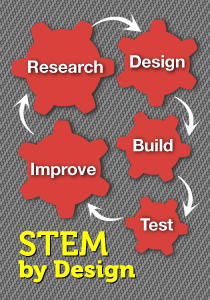 What do STEM teachers do?
STEM teachers pose problems and combine problem solving with project-based learning across disciplines. They work together with students on activities to develop students’ critical thinking, communication, assessment, and inquiry skills.
That’s an impressive job description; however, even after a decade and more of STEM programs, the teacher preparation system for STEM teachers can still be (as an NRC report put it in 2013) “chaotic, incoherent, and uncoordinated, filled with ‘excellent programs, terrible programs, and many in between.’” Whatever your background and training for STEM teaching, we’re here to help!
What Good STEM Lessons Do
While things seem a bit muddled on the STEM teacher preparation front, we do know some things about STEM curriculum. We know, for example, that a good STEM lesson accomplishes these things:
- Helps students apply math and science through authentic, hands-on learning
- Includes the use of (or creation of) technology
- Involves students in using an engineering design process
- Engages students in working in collaborative teams
- Appeals equally to girls and boys
- Reinforces relevant math and science standards
- Addresses a real-world problem
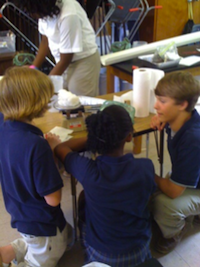 Problem solving is really the heart of STEM investigations. Providing students with real-world problems to solve fuels their curiosity and investigative interests. In its policy paper on establishing effective K-12 STEM education programs, the National Research Council reports that students in high-performing STEM programs will have opportunities to learn science, mathematics, and engineering by addressing problems that have real-world applications.
Providing students with real-world problems and asking them to brainstorm solutions will bring their higher order thinking skills into play. But for me, identifying real-world problems that students can solve is one of the hardest parts of creating STEM lessons.
They have to be problems that students can reasonably grapple with. And those all-important problems may need to synchronize with a specific set of math and/or science standards from the school system’s pacing guide. Hopefully you don’t have that constraint, but realistically you probably do.
Sites for Real-World Problems
I’ve located some sites that help me come up with real-world problems, and I’m always on the look-out for more. I’m going to share several sites I’ve identified, and I hope that you’ll share some as well. I invite you to click on these sites and mull over the possibilities.
The National Education Environmental Education Foundation is a great site for problem hunting. The site correctly avows, “Solutions to 21st century environmental challenges often result from STEM knowledge and skills. Hands-on environmental education projects enrich STEM learning and offer an exciting opportunity to engage more students in STEM. The possibilities are endless – from calculating school water usage to observing, documenting, & protecting wildlife populations in the schoolyard.” 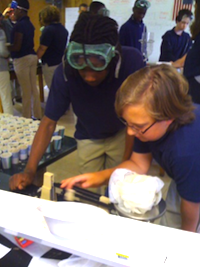
In the Greening STEM section on this site you’ll find ideas for relevant problems. Most environmental topics can fit under standards for either life or physical science, so these may provide you with some real “kid-catchers,” or ideas that snag students’ interest.
Topics include areas such as:
• Oil spills
• Water pollution
• Air quality
• Endangered species
• Environmental Health
Another favorite site of mine is the PBS Design Squad Global. They have some real-world problems there that I find intriguing. For example student teams might invent these:
• Band Instrument
• Electric Gamebox
• Confetti Launcher
• Solar Water Heater
• Speedy Shelter
How cool are those ideas? As a middle school science teacher, I found STEM to be a natural fit for most of the topics I taught. Math, however, seems to be a different matter.
The Problem with Math
One issue I hear repeatedly is that math teachers find it difficult to identify real-world problems and implement STEM projects in math classes. (Note that these math teachers are not able to work collaboratively with science teachers to develop/implement lessons, and must therefore “go-it-alone.”) However, the math teachers who mentioned this are looking determinedly for ways to implement STEM lessons.
The Common Core Standards state: “Mathematically proficient students can apply the mathematics they know to solve problems arising in everyday life, society, and the workplace.” This adds urgency to the search for real-world problems that bring in appropriate math standards.
The Tennessee STEM Innovation Network has a variety of lesson ideas for Grades 6-8 that give full attention to math standards. In particular, under the MIDDLE category, see the Agriculture STEM Module and Lesson Plans and the Manufacturing STEM Module and Lesson Plans for STEM lessons for grades six, seven, and eight. Here’s one example for 7th grade.

Teach Engineering
No list of real-world problem ideas would be complete without mentioning the Teach Engineering lessons. As you peruse these, read the summary of the lessons rather than relying on the titles. Look for projects that include hands-on ideas, such as those involving microbes, rocket-powered boats, solid fuel reactants, the fisheries bycatch problem, and so on. Notice that many of the lessons have hands-on “Associated Activities.” These generally hands-on investigations bring the “E” in STEM to your students.
I hope these sites will be of value to you, and will assist you in brainstorming ideas for real-world problems. Feel free to share comments or sites of your own. We’re inventing a new specialty and need all the help we can get and share!
For even more STEM lesson ideas, read Anne’s 2018 posts:
How to Make or Find Good STEM Lessons
and
Design Squad Global’s Super STEM Resources
and her 2020 post:
Need a Real World STEM Project? Try Plastics Pollution
You’ll also find teaching ideas at
Anne’s STEM by Design book website
















Hello Anne.
As a new STEM coordinator, I have to give a STEM presentation to principals for my charter schools. Can you suggest and lessons, books. power points,etc. that would be advantageous?
Fondly,
Linda Schwerer
Pinellas Academy of Math & Science
Hi, Linda – I have a couple of ideas . . . If you contact Susan Pruet – Director if Engaging Youth through Engineering (you can google it) she will send you a copy of a free STEM launcher. It’s a lesson intended to demonstrate the STEM process. You could lead your principals through it if you think they really need a better understanding of the difference in STEM and science experimentation. You could also distribute it to your schools for teachers to use as a launcher into the STEM way of thinking. It has PowerPoint slides with it.
An online document that you might like to look at is “STEM Teachers in Professional Learning Communities: From Good Teachers to Great Teaching.” You can google this document online as well as a National Academies Press document titled “Successful K-12 STEM Education: Identifying Effective Approaches in Science, Technology, Engineering, and Mathematics.”
I’m not sure if you’re trying to introduce these principals to the idea of STEM and convince them that they need to do this, or if you’re trying to show your principals how to do this. Those are two separate presentations – at least.
Good luck with your preparation! You have a lot of research to back up the need for STEM!
Thank you so much Anne! I will get to work! Your advice is very helpful!
I realize this comment is 3 years old, but I came across it just now. I would like to know if Susan Pruet is still available to get that free STEM launcher you mentioned – a lesson intended to demo the STEM process. I would love this.
Thanks!
Harry – thanks for asking. This is still a popular post at MiddleWeb! Anne Jolly’s January 2017 blog post shares the Launcher activity: Launch the New Year with STEM Mini-Lessons!
Thank you! Much appreciated from a fellow Alabaman. (correct use of that word? :) )
I love the STEM idea. But, as a 7th grade math teacher, I don’t see a place in STEM programs to ensure that students understand the basic math skills required by educational standards. For many kids, it takes a long time to understand and be able to apply math concepts. With STEM programming focusing on the project-based approach, where does mastering basic skills fit in?
Hi, Paula,
Mastering math skills and applying them through STEM isn’t actually an either-or situation. If kids see reasons for what they are learning, they tend to learn more deeply and quickly because they are actually engaged in the content. I’ve worked with STEM courses that made use of math that the kids had already learned. I’ve also worked with STEM projects that taught the math kids needed in order to solve the problem. Both were effective. The real purpose of STEM is to ensure that math and science students learn their content more deeply. If that isn’t working, then we’ll need to keep adjusting until we get there. Thanks for asking!
Hi Ann,
I am a third grade teacher and currently co-chair a curriculum committee to develop a summer program for Kindergarten through 3rd grade. I am having trouble finding age appropriate STEM lessons for kindergarten through 3rd grade. Do you have ideas or suggestiosn as to where I can start? Thank you.
Hi, Mary! So glad you’re working on developing a summer program. I know someone who’s been there, done that, and I’m going to put you in touch with her. Her name is Susan Pruet and her email is susan.stemworks@gmail.com. Please shoot her an email and she’ll be happy to tell you about what materials, etc. she uses.
I’d also take a look at the Engineering is Elementary (EiE) curriculum from the Boston Museum of Science. Those are quite thorough and good.
Hi Ann
I am a seventh grade science teacher and we are in the early stages of implementing STEMS at our school site.Can this program incorporate all content areas, history, language arts, math and science all in the science classroom? This is not my understanding of how it should be taught. I understand the math and science but to include what the history and language art teacher is teaching doesnt seem to work.
I am hoping you can clarify this for me.
Hi, Darren. Wow. You’re gonna be sorry you asked me this . . . my answer won’t be short!
For me personally, STEM includes an indepth, integrated focus on science and math, and on using the engineering design process to solve real-world problems. Technology may be used to help with the solution, or teams of kids may create technology as part of the solution. (Anything made by humans to meet a want or need is designated as technology). This in-depth focus on science and math through STEM has come about as the result of a 21st Century workforce with an increasing need in STEM fields and a lack of STEM-prepared workers. The math and science deficits are sending our industries abroad to find workers qualified for our 21st century workforce.
Now to your question. I see a place for art in the STEM product design – it could be used to make the product teams produce more appealing and desirable – although that may be for the art teacher to work with if it’s going to involve knowing art design principles.
Likewise, you have to use some form of language arts in the communication process (communication is part of the engineering design process); however, it’s used naturally as teams work together to solve the engineering (STEM) challenge and to publicize their solutions. It’s not used try to accomplish specific language arts objectives.
History might be incorporated if you need to set some sort of context for the engineering challenge. But I can’t visualize incorporating specific history objectives during a STEM challenge unless they happen to be a natural fit. And unless you need a historical context for the challenge.
Doing a “force fit” with other subjects doesn’t make much sense to me. Not to mention – class time is already at a premium. STEM work, with its inquiry-based approach, already requires more time than a traditional science (or math) class.
The fact that all subjects are not taught directly in an engineering challenge doesn’t lessen the value of those other subjects. Again – it goes back to the need we’re attempting to meet by going deeper in math and science content through an engineering process.
So for me, in a STEM project students focus on using science and math to solve real world challenges, and they use the engineering design process to bring structure and process to doing that. Language arts and history are always appropriate to the extent that (and if) they add value to the STEM challenge. They shouldn’t be add-ons just for the sake of adding them on.
Remember, however, that there is an intense focus on the science and mathematics objectives in a solid STEM program. And this works best when these two subjects are integrated and the math and science teachers work together on teaching STEM projects.
Now, aren’t you sorry you asked? Seriously – remember this is MY opinion and STEM has other looks as well. I’d advise you to listen openly to the need for including other subjects as explained by your principal or other decision-maker. Then – rather than pushing back – in a positive manner explain how these subjects could fit naturally during the course of the STEM projects. Also explain what you expect to accomplish for your students through STEM and note the limited time you already have. Let me know how it goes. :-)
Hi Anne,
I am looking for STEM lessons that I can incorporate in my middle school Math Enrichment program which is for advanced math students in grades 6-8 and meets for approximately 10 weeks during the school year. I have been given the charge of creating a Math/STEM enrichment program/curriculum and am looking for resources to help. Currently, our school is implementing STEM curriculum/projects in the Science classrooms, but I need to find more of a mathematical slant. Thanks for your help…..I am so glad I found this website!
Hi, Sharon,
Math is one of the under-resourced areas in terms of lessons that apply real, grade-level math. I’ve seen so many lessons that ask students to “find the average” (my math teachers say it should be “find the median”), and then the writer feels that math has been sufficiently covered. NOT! Some areas of math that I’ve seen successfully developed into STEM lessons include applying what middle school students have learned about flow rate, unit rate, scaling and proportion, and statistics, to name a few.
Susan Pruet – a real math guru – will be writing a post for this blog in August. She’s going to address how math teachers can be STEM teachers, and will give some examples.
Some of the better math lessons I’ve found and adapted are from the Design Squad. This one – making cardboard furniture (http://pbskids.org/designsquad/build/paper-table/)- uses geometry. Try browsing around there for ideas. The Design Squad site also has links to other sites as well.
I’m SO glad that you, a math teacher, are taking on this task. Applying math will eliminate forever kids asking “Why should I learn this?”
Keep us posted, and stay in touch.
Thanks for your reply. I will be looking for the post in August and I will look at the Design Squad site as well. I too feel that Math takes a back seat to Science when STEM programs are created and implemented. I hope to change that! I will keep in touch and again, I appreciate your reply and support!!
Hi Anne,
You are providing amazing resources – thank you! I am starting a STEM program for all 6th, 7th and 8th grade students in our middle school. They will have STEM on three consecutive days (3 – 45 minute blocks) for 12 weeks. This will be a very exciting introductory year for us! My challenge is to design the curriculum this summer, though. I am searching for any type of “canned” curriculum to purchase as a start and then to develop from there. Can you provide any suggestions?
Thanks so much!
Hi Nancy,
I, too, have been given the charge of STEM curriculum writing for grades 6-8 in mathematics during the summer. If I find anything useful, I could let you know. It is a daunting task!!
Hi Sharon, Yes that would be excellent, and I will do the same!
Nancy
Hi Nancy
I found a great resource for STEM projects on TeachersPayTeachers.com
It is: 21st Century Math Projects. The emphasis is on Math, but STEM oriented. Check it out!
I checked it out, too, Sharon . . . I can’t see to what extent it mirrors STEM lessons, but it certainly seems to do so from what I read. And I love the fact that it’s written from a math perspective. Thanks for pointing out this resource!
Wow. What a feat to accomplish over the summer, Nancy!
Several “For purchase” STEM packages are out there, but I can’t recommend any in particular because I don’t know enough about them. You want your STEM program to integrate math, science, and technology, and to follow an engineering design process. (It’s the engineering piece that many would-be STEM curricula leave out.)
I’ll put out the feelers and see if any show up on the horizon. Check my Twitter feed at @ajollygal – I may get some responses there.
Good luck!
Thanks so much, Anne! I am a bit overwhelmed at the moment, but simultaneously excited about bringing STEM to our school! I appreciate any help or guidance – I will check twitter as well.
Nancy
I am a parent of a 3rd grader who has been given the task of doing a stem project, and I have no idea how to help her, or what I am looking to do. I do not understand what this curriculum is. Can you please explain to me what I’m supposed to be doing with her
Hi, Jean,
STEM curriculum helps kids apply the science and math they learn in a real world situations. Parents can help a lot with the STEM skills kids need. Here are some posts that contain information I wrote mostly for parents. See if these can give you the information you’re looking for.
http://www.middleweb.com/3569/10-stem-tips-for-parents/
http://www.middleweb.com/15579/ideas-activities-stem-summer-slide/
http://www.middleweb.com/22787/reinvent-summer-learning-make-it-up/
Thanks for your question, and for looking for ways to help your daughter in STEM!
please suggest me some hands on activity on maths for 10-15 yrs of age
I am a technology teacher for grades 3-5. I am looking for STEM problems my students can do on the computer. Any ideas?
Thanks for the information on applying STEM. I am actually a spatial ecologist that is teaching gr7-9 mathematics at a small school in South Africa. I feel that we came up with a brilliant idea of how to combine Math and STEM (for those Math teachers that were uncertain). I combined our focus on insects (biology) for the term with all the data chapters (collect, organise, summarise, interpret and report). The learners were tasked with creating a question that we wanted to answer regarding insects and using the data cycle/scientific method (above) to develop a plan how to answer this question. The learners decided to do a survey of insects at the school. They set up a plan of how to collect the insects, did so and then analysed the data and reported their findings. They had to include a section on possible errors/bias in their data. I admit that this is one of the easier sections in math to incorporate into a STEM-type approach but I provide it as an example. The kids loved it!
Thank you so much, Marie! Integrating math and science fits naturally in your example. I appreciate your sharing your idea here, and I wonder if you’d allow me to share it on my website – http://www.stem-by-design.com/.
You are more than welcome to share it. I think often we are unaware of how what we are doing can be related to STEM/is STEM! (Pls leave my e-mail address anonymous). Thank you Marie
Hello,
I work in the scholastic department of a wastewater treatment plant. We provide hands on STEM outreach to schools and community. We are preparing for our second year STEM camp for high school students. Last year we partnered with a local university and focused on microbiology and chemistry. This year we are looking for some additional engaging ideas to incorporate into our 5 day camp. Are there any recommendations that you can provide? Thank you
Hi Ron,
I am going to be teaching a Medical Microbiology class this fall. I would love to know how you focused on microbiology and what lessons you may have used. The University of Texas has potential to help us. What university department did you work with? Thanks for any help you can give me.
Hi Ann
I am a STEM instructor, using lego materials as hands on instruction materials,how do I make my class more interesting and innovative. I need ideas on how to make my class a real world problem solving session,please your kind recommendations. Thank you
Try this idea . . . your kids should have a real reason for building whatever it is they make with the Legos (or any other materials). Suppose they are studying the human body in science. They could use the Legos to construct a prototype of something to solve a problem – perhaps a model of a miniature artificial arm or leg that would help a disabled person, If the kids have a reason for making something and the freedom to come up with their own designs, this often stimulates interest and innovation.
I am looking or some STEAM projects for 4-5th graders to work on in relation to Earth Day. Does anyone have any suggestions? We are just starting to implement these into our classes at school which ranges from Prek-8 so suggestions for any grade level are welcome and I will pass them on.
Hi, Anne,
Thank you for all of your valuable STEM resources! I’ve enjoyed reading/researching through your site!
I am new to teaching a middle school 9-week STEM class for 6th graders. As of right now, my curriculum/materials consist of a canned STEM program that has zero depth.
I’ve been tasked with overhauling the class – developing a true STEM curriculum. Do you know of any middle school models I could research?
I’d appreciate any help.
Hi, Sarah,
Take a look at this STEM launcher on my website at http://www.stem-by-design.com/use-mini-lessons-to-launch-stem-projects/. It will help your kids get engaged with the “E” in STEM. It’s written for use in math+science classes, but it would be simple to modify and use with your kids. I have two more launchers I can send you if you like this one.
Another idea – look around the website while you’re there. There are plenty free resources and tools (click on the tabs at the top) and you are welcome to use (and modify) any of them.
If you want to check out my book – it has suggestions for developing STEM lessons. If you have a chance to develop STEM projects that carry over from one time the kids meet until the next, that’s the best look. If you only see them once a week or so, then that’s a bit more of an issue. If you want to email me we can probably “chat” more over email than here. jollyanne@gmail.com
Thanks for being a STEM person!
Thank you, Anne! I appreciate your suggestions and resources. When you get a chance, I’d love to take a look at the other launchers.
Hello! I am a 11 year old kid going to Somerset Academy. I am doing a STEM project like all of else as well. I am working with two other friends on this project. In our project there is some different things we must do. Most of all we need to make a product that solves an everyday problem. Our group created and idea with ice cream. Our product name is Drip Catch. It is basically a plastic cup for our ice cream cones whenever it melts. The Ice cram will just fall into the cup looking thing. But….. it does not really work. So I am asking for an idea that is a product that solves everyday problems.
I also forgot to mention I am in 5th grade. Please help me. You only need to give me an easy/ OK difficulty stem project. But.. it must be a product we created and it HAS to solve a problem.
Hi, Jaden,
What a neat assignment! I like the Drip Catch idea – I wish it had worked. Can you redesign it so that it will work? I think its a great start.
Let me tell you where you can find some good ideas for STEM projects. Go to the Design Squad at http://pbskids.org/designsquad/projects/. At the top of the page, click on “Design” or click on “Build.” There are some pretty good ideas there.
I read of a group of kids who designed Popsicles with vitamins in them. Here are some other problems kids tackled. http://read.bi/2DoiBSY Just scroll down to see them.
Have you ever noticed that kids on crutches have a problem carrying things around? Is there some sort of carrier that can be added to crutches so that kids can carry things?
Keep your eyes open. Look for a problem you can help in your community or at your school.
Good luck to you and your friends. I hope you’ll come back and post what you finally decided to do. I bet it will be neat!
Thank you very much! I looked at the links you provided and got some new ideas. But.. my friends and I decided to keep doing the Drip Catch idea! But thx for your help! Bye have a great day/
Thanks, Jaden! Let me know how the Drip Catch works. I thought it sounded like a useful and original idea.
Tom is the STEM fair and we finished! It looks amazing. We made the drip catch with a plastic container and cut it into a circle and a hole inside. SO ready for tom!! Thank you so much.
Good luck!!
HI Anne I am in the process of starting a STEM Summer Academy for 6-8 graders, looking for projects in STEM that will motivate the students
Hi, Sonia,
Take a look at “Engineering Is Elementary” (EIE) Curriculum Units. You can find them at( http://www.eie.org/eie-curriculum/curriculum-units.) While they are designed for up to 5th grade, they are easily adaptable for older students.
Also check out “Engineering Adventures” at https://www.eie.org/engineering-adventures/curriculum-units.
“Engineering Everywhere” (www.eie.org/engineering-everywhere) is a free Middle School curriculum you may like. It’s designed for youth in afterschool and camp programs.
Another place I go for just fun activity ideas is the Design Squad (pbskids.org/designsquad/projects/)
I hope those give you some good ideas!
Thank you I will keep you posted on how it turns out ; any ideas for projects
Hi there,
What a great resource! I am currently teaching in a small school of 22 P-6 students and have been asked to complete a 1-1.5 hour Maths Problem Solving Session with a STEM focus each week with all of the children.
Can you please put me in touch with some resources/activities that are hands on and suitable for multi age/abilities?
Hi, Karlene. One resource that seems popular is the Student Teaming Guide, and it’s a free download on my book website (www.stem-by-design.com). To get it, click the tab at the top of the webpage titled Student Teaming Tips. Scroll to the bottom, and download it and share it.
You may enjoy looking around the website as well. You’ll find plenty of free tools, tips, and teaching ideas there. You’ll also find a free STEM Launcher (a mini-lesson called Stop, Drop, Don’t Pop) to introduce engineering to your students. (http://bit.ly/2Cvb2cw) Scroll toward the bottom of the page and you will see 3 pdfs you can download, use, and share.
In my MiddleWeb blog I write about all sorts of topics from lesson design to including girls in STEM. You may wish to look at some of those resources as well. In fact, I’ve just posted another launcher there – the ‘Bama Bears – to help kick off STEM (the engineering component) for 2018.
I also came across another good muliti-grade level resource that I think you’ll like. Take a look at this site: http://bit.ly/2IaNeda
I hope some of these help! Thanks for your work with STEM.
I forgot to include the link to my MW blog – it’s https://www.middleweb.com/category/stem-by-design/
Hi Anne,
I’m involved in our school’s pilot STEAM classes and found the resources in your post helpful. I’ve used TeachEngineering quite often to help me get ideas.
About the problem with maths, we’ve had the same concern but what we’re aiming to do in our next project is getting the students to collect data themselves than using made-up ones. We think that the authenticity of these activities will increase students’ level of motivation.
Great idea, Ms B! Authenticity is, indeed, the key.
Also consider checking out some of the big math grade-level concepts and targeting one or more of those specific concepts for a STEM challenge. We did that with flow rate. We did an environmental STEM project that dealt with water erosion (that was an authentic problem for our school.) The kids used flow rate to measure and calculate the effectiveness of their barriers. Then they redesigned them and got much better results. And . . . they finally saw a practical use for learning how to calculate flow rate!
.
I am the middle school science teacher at a Christian school and is desirous of coordinating and developing a STEM curriculum. I have heard a lot about STEM but want to have a clear focus on how to start this first in the middle school then to the rest of the student body.
Hi, Edmund,
What an exciting adventure – starting to implement STEM in the elementary school. That’s certainly the right way to do it. Start with this article on building a foundation with elementary STEM: https://www.middleweb.com/26244/building-a-foundation-with-elementary-stem/. If you haven’t checked out my latest book, STEM by Design, it’s published by Routledge/MiddleWeb. Among other things, this book shares practical tips, principles, and strategies for implementing STEM in Grades 4-8. Those principles can be applied at earlier grades as well.
You may enjoy looking around the book website as well at https://www.STEM-by-Design.com. You’ll find plenty of free tools, tips, and teaching ideas there. You’ll also find a free STEM Launcher (mini-lesson called Stop, Drop, Don’t Pop) to introduce engineering to your students. I’ve posted another launcher – the ‘Bama Bears – on my MiddleWeb blog site. You can modify both of these to help kick off STEM (the engineering component) for this fall.
hii, i’am education student , and i want to work on stem activity based on problem solving for grade 4 to 6 math student , but i don’t have any idea what should i doo :(
One place to start is looking at issues in your community. Also checking news geared towards kids (news depth, TFK, and National Geographic. Then get creative around the engineering design process.
You might also check out Design Squad Global, Dana. There are a lot of super STEM activities for all grade levels on that site. Good luck with your STEM activities.
Hi Anne, I don’t teach but I was wondering if you could give me ideas for STEM ideas for some of my peers. It is a school project so I’ve got to knock it out of the ballpark. Appreciate it. Thanks. Please get back to me before 2/20/19. Thanks again.
Hi, Yen-Dow,
A couple of suggestions that will help you find ideas: Go to Design Squad Global Lesson Plans. (https://to.pbs.org/2XcjPXBd/). They have some amazing ideas there.
You might try this MiddleWeb blog post I wrote. (http://bit.ly/2BK3qmS)
And look at Science Buddies. They have a lot of good resources there. (Note: The Science Buddies site requires a free account to access all the details. Just takes a minute.)
I hope those suggestions will be of some help!
Selam,
Türkiye’de ilkokul öğretmeniyim. Bio ekonomi ile ilgili STEM projesi geliştirmek istiyorum.Fikirlerinizi almak benim için muhteşem olacaktır.Teşekkür ederim.
Selam, Candan. Thanks for teaching STEM to elementary students.To find ideas for bio economy projects, please go to this link: https://www.middleweb.com/39326/how-elementary-stem-can-meet-the-future/. At the end of this article you will find links to six sites that have good lessons you may be able to use. I hope this helps, and please continue your good work.
Hello Anne, Such a wonderful site! So I am interested in researching teacher’s beliefs about integrated STEM education and if it can improve science and math skills for my dissertation. I am planning to explore authentic tasks in both science and math. What do you think about this idea? How can I explore this topic in greater depth? Can you recommend me some readings? Should I use the same authentic activities for both math and science or can I use scientific inquiry in science and models in math? Hoping to hear your thoughts.
Also, I forgot to mention that I would be focusing on primary schools so if you can suggest me some readings.