
Rikki Tikki: How I Use a Touchstone Text
 In just the past few weeks, I have found myself returning with my students again and again to a text we used in the very first weeks of the school year.
I start my students off each September with a read-aloud of Rudyard Kipling’s short story “Rikki Tikki Tavi” as a way to introduce an array of literary concepts.
We are deep into our novels right now, and yet, that courageous mongoose sneaks his way into our conversations on a fairly regular basis. Here are ways that I referenced the read-aloud story in recent days:
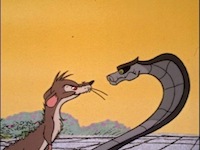 What character-trait describing words did we use to describe Rikki-Tikki? How about Nagaina? Now look at our novels and choose a character ….
- How did the setting play a role in “Rikki Tikki Tavi”? What do you remember from the story that supports your idea? In our current book, the setting is also …
- Let’s think of plot and theme. What was the plot of “Rikki Tikki Tavi”? What do you think was the theme of the story?
- There’s an example of foreshadowing? Who remembers what Rudyard Kipling did in “Rikki Tikki” to set the stage for Rikki to be a hero?
- What kind of evidence would we have used from “Rikki Tikki Tavi” to support that idea?
- Try to see the event from another character’s viewpoint. How do you think Nag and Nagaina saw the arrival of Rikki Tikki to the garden? Think of how different characters can have different perspectives on the unfolding of a story …
I consider “Rikki Tikki Tavi” to be my main touchstone text, one that I will revisit with regularity right through the end of June when the school year comes to a close. With its fast pace, focused conflict and resolution, use of foreshadowing, historical connections, and clear delineation of protagonist vs. antagonist, the story covers a lot of important ground in a very short amount of time.
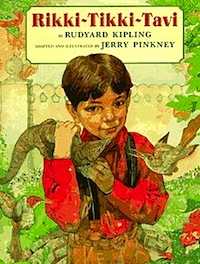 As the school year begins, I present the story as a read-aloud — using the Jerry Pinkney picture book adaptation, which is pretty faithful to Kipling’s original language and has wonderful illustrations. I do this because I am not yet certain of the reading levels of my students. Plus, the elevated importance of “listening and discussing” represented in the Common Core is something I consider.
Above all, I love reading the story and the students always enjoy listening to it.
Creating a collaborative memory
Unlike a mentor text, which might have a specific role for a specific skill or focus, a touchstone text is one that gets revisited early and then often, developing a sort of collaborative memory that the class shares together. Choosing the right text for a touchstone is tricky, and it did take me a few years to settle on the Kipling story. Other stories did not seem to engage my students on the same level, nor with the same longevity, as did “Rikki Tikki Tavi.” Boys, in particular, are drawn into the story’s conflict. I hook them early with story, in hopes the hook remains in place through the year.
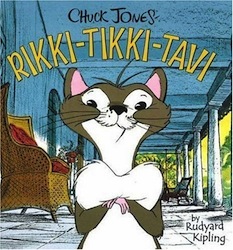 One year, I did an interesting experiment with my students. I read through only half the story. Then we watched the Chuck Jones’ television version (with Orson Welles’ deep voice booming out of the speakers as narrator) so that the video became the entire story text they experienced. I then surveyed my students on this process and surprisingly, most were not at all happy with not having me completely finish the book first. I was the voice of the story in their ears. I was the voice they wanted to hear finish it. (Take that, Orson Welles!)
They did, and students still do, enjoy the animated Chuck Jones version of the story, and most have not seen it before. The number of students who have seen the movie or even heard of the story itself drops every year. But many of my students expressed a strong feeling of being disjointed by my text-video experiment, so I went back to reading the entire story out loud each year and then watching the video afterwards (before launching into a writing piece about the characters, of course).
Many months into the school year, elements of “Rikki Tikki Tavi” make their way into our conversations about reading and writing. Rikki lives on in our classroom, as does his story. Now, that’s a touchstone text.












Kevin,
I’m a curriculum leader at YES Prep, a charter school system in Houston. Reading your description of how you use this touchstone text confirmed a lot of the thinking our team has been doing recently about the importance of spiraling (constantly!) knowledge & skills while also holding students accountable for prior knowledge & learning (assuming they can & providing space for them to retrieve repeatedly, as opposed to lamenting “my kids never remember…”). Additionally, your example provides a great vehicle for pushing rigor via connections/synthesis across texts; the frequent use of the touchstone as a regular routine in class undoubtedly leads kids to become aware that looking for patterns & connections across texts is just something strong readers and writers do.
I’ve shared your article with members of my team & forwarded it on to others.
Thanks!
Jeremy Tullis
Thank you for sharing!