Leadership Strategies That Get Results
High-Payoff Strategies: How Education Leaders Get Results
By Jody Spiro
(Wiley/Jossey-Bass, 2016 – Learn more)
 Reviewed by Matt Renwick
Many educational resources for school leaders seem to fall into one of two categories: descriptive and prescriptive.
Descriptive resources convey the author’s or subject’s experience leading and learning in schools. One of my favorites in this category is Future Wise: Educating our Children for a Changing World by David Perkins.
Prescriptive resources offer the school leader specific strategies for bringing about change through a new initiative. Check out Designing and Implementing Effective Professional Learning by John Murray. A few books meld the prescriptive and the descriptive with big success. One that immediately comes to mind Read, Write, Lead: Breakthrough Strategies for Schoolwide Literacy Success by Regie Routman.
A toolkit of strategies and templates
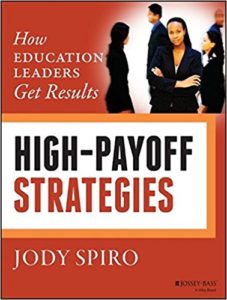 High-Payoff Strategies falls into the prescriptive category. The author, Jody Spiro, is the Director of Educational Leadership at the Wallace Foundation. She also wrote Leading Change Step-by Step: Tactics, Tools, and Tales.
In her newest publication, Spiro presents her text as a toolkit of strategies and templates for school leaders to facilitate change in schools in districts. She offers three specific strategies for this work: culture, instructional improvements, and learning communities. The book rounds out with “The Payoff” in which all three strategies are brought together to achieve the school/district vision.
A strength and a weakness
Where the book succeeds is in the specific tools shared. For example, the “Measuring-the-Culture Exercise” on pages 49-50 looks like an effective method for finding out what is most important to the faculty and school community. Spiro offers a step-by-step procedure after the template for leaders to follow. She also gives an example of results from one elementary school, along with what she would do as the principal regarding next steps based on the information presented.
However, where the book falls short is in trying to tackle three major strategies within the confines of a short text. Culture, instructional improvements, and learning communities each have many publications focused on that single strategy. For Spiro to take on all three seems like too tall an order. She could have devoted a prescriptive text to any one of these strategies and taken a deeper dive into the topic. With that, I believe the reader can pull some useful ideas and practices from High-Payoff Strategies, but they shouldn’t expect anything more.
 Matt Renwick, a veteran teacher and school leader, is currently principal at Mineral Point Elementary in Mineral Point, Wisconsin. He’s the author of several books, including Digital Portfolios in the Classroom: Showcasing and Assessing Student Work (ASCD, 2017) and 5 Myths About Classroom Technology (ASCD Arias, 2015).