Effective Questioning During Virtual Learning
By Barbara R. Blackburn

Students are naturally inquisitive. However, in today’s technological society they have been accustomed to simply “googling an answer.” Part of our job as teachers is to teach them how to ask and answer questions, moving beyond what they can find on the internet.
Many years ago my father, who was also a teacher and professor, shared his perspective on the purpose of education. He said, “You’ll know you have been successful when you have taught students how to figure out what to do when they don’t know what to do.” That is the essence of teaching.
Good Questioning
First, we should consider the aspects of good questioning that are applicable in on-site and remote instruction. Teachers who are effective questioners actually ask fewer questions, but they ask questions that are at higher levels of thinking and require more depth in the response. They differentiate questions based on students’ needs while ensuring rigor that is appropriate. Finally, teachers use wait time to demonstrate high expectations, and probe and scaffold when students struggle.
Levels of Questioning
Many questioning models are available, including Webb’s Depth of Knowledge, Bloom’s Taxonomy, Costa’s House, and the Cognitive Rigor Matrix. These models, one or more of which you are probably already using, are applicable in a remote setting. You’ll use these as you teach synchronously as well as when you are designing asynchronous tasks and assignments.
FIRE Questions
I recently found a different model of questioning that may be helpful. Yilin Sun shares that teachers can create FIRE questions.
► Factual Thinking Questions – gathering factual information and applying it to a given problem in a way that is clear and relevant.
► Insightful Thinking Questions – which ask students to look at the big picture or assumptions, interpret information or give different perspectives, focus on depth, and look for solutions to situations or problems.
► Rational Questions – which ask students to analyze connections among both facts and implicit assumptions or focus on breadth.
► Evaluative Questions – in which students focus on feelings and values that affect decisions, interpretations, or analyses.
I especially like that the FIRE questions provide a wide range of deeper level questions. This can be particularly useful when creating a prompt for students to answer, perhaps on a shared document.
Question Stems or Starters
Question stems can be a useful strategy to jump-start student questioning. Although these can be used in a synchronous lesson, particularly for breakout rooms or chat responses, they are ideal in an asynchronous one. When asking students to complete a task, whether independently or in small groups, provide several starting points they can use to process and organize information. Here are a few examples.
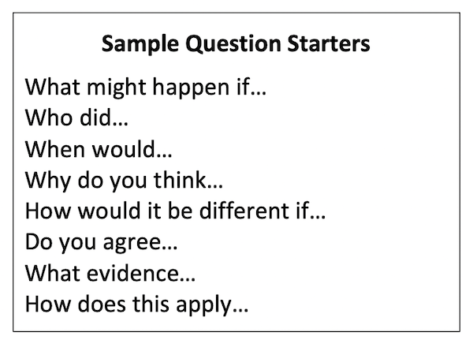 Although you may want to have generic questions, those that are customized for the task or assignment are generally more effective. For example, when asking students to solve word problems in a math classroom, I might use starters such as “I think I know…”, “From the problem, I know…”, “The answer is…”, “I know this because…”, and “Another way to solve it is…”.
Cubing
When I was a classroom teacher, I used the process of cubing, in which students roll a die or cube and use the prompt on the side to create a question. The prompt may have been as simple as who, what, when, where, why, and how, or it may have been more complex.
You can tailor the cube questions to your needs. For example, the advanced cubing prompts below are great to use in a social studies, science, or English/Language Arts classroom.
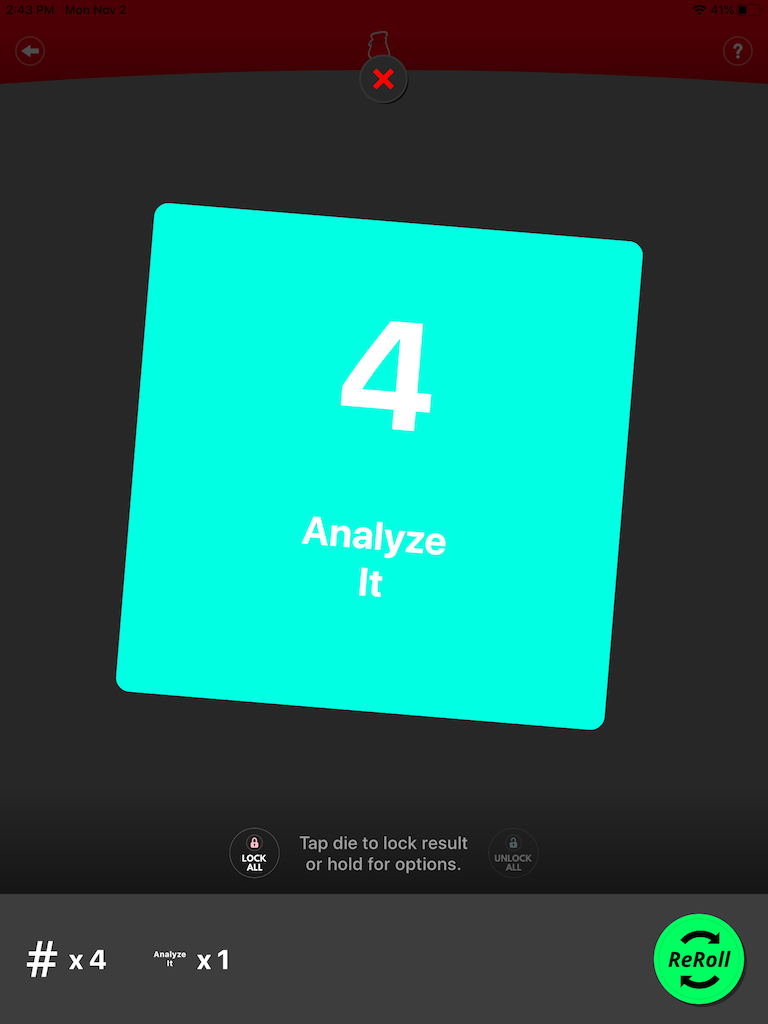
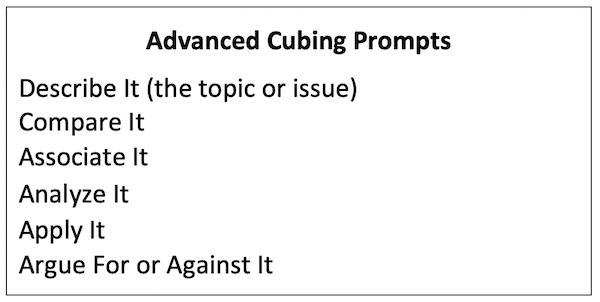 In a remote setting, you can adapt cubing. First, prepare a list of question starters numbered from 1-6. As students are working together in a small group, students can roll the virtual die using a website such as random.org. They check their number against the list and use the question starter to ask a question to their group.
If you want to create custom virtual dice, look in the Google Play or Apple apps stores for an app like “Roll My Dice” (below) which allows you to add text or images to many cube shapes.
Identifying Which Questions Are Relevant
One challenge students face when creating and answering a variety of questions is identifying which questions are or are not relevant. There are two ways you can teach them a strategy in a remote learning setting.
First, tools such as Socrative, Kahoot, and Quizziz allow you to create lessons or practice opportunities for students. Next, I’d recommend you create a video with modeling and examples, ideally customized to your specific content. Although you may teach a lesson in a synchronous setting, having a recorded video that students can reference at any time is helpful.
Asking and Answering a Question
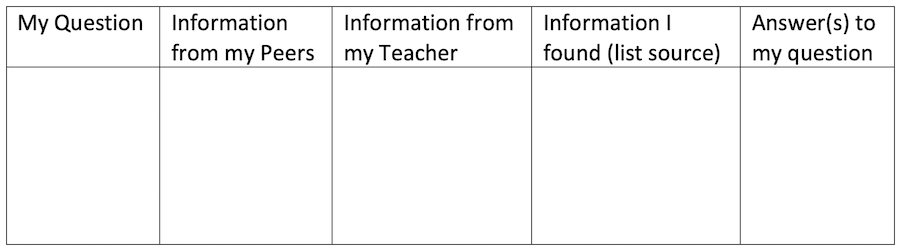
Finally, when I was teaching, there were times that my students would answer a question but were unable to tell me why they knew the answer. I was frustrated because I wanted them to not only explain their answer but provide supportive evidence. I found that using a graphic organizer to help them chart their process was helpful. The organizer can be completed through a shared document.
A Final Note
Effective questioning during remote learning does not mean recreating your instruction. Rather, if you build on the characteristics of effective questioning, build your questions around models of higher order thinking, use questioning stems and cubing for both student scaffolding and independence, and use strategies to teach students to work with questions at a higher level, you will see your students rise to new levels of success.
 Barbara Blackburn (@BarbBlackburn) has been named one of the Top 30 Global Gurus in Education in 2020. A former teacher, school leader and university teacher educator, she is a best-selling author of 21 books including Rigor is Not a Four Letter Word and Rigor and Differentiation in the Classroom: Tools and Strategies (Routledge/Eye On Education, 2018). Her newest book, with Melissa Miles, Rigor in the Remote Learning Classroom, was published in September, 2020.
A nationally recognized expert in the areas of rigor and motivation, she collaborates with schools and districts for professional development. Barbara can be reached through her website or her blog. Follow her on Twitter @BarbBlackburn.