Mental Time Travel for Student Well-Being
By Stephanie Farley
 A lifelong sci-fi and fantasy fan, when I see the words “time travel,” I’m in. Fueled by classic time travel yarns like H.G. Wells’s The Time Machine and Ray Bradbury’s “A Sound of Thunder,” I’ve spent countless hours imagining where I would go in a time machine and how I would make the world better not just for me and mine, but, humbly, for all of humanity!
I’d stop Hitler and James Earl Ray in the past and then travel to the future to learn the technology for healing people with the wave of a non-invasive device, a la Star Trek. Obviously, I’m not alone in these plans, as stopping Hitler is the plot of Inglourious Basterds, a 2009 film by Quentin Tarantino. In my dreaming, I’ve dismissed the notion that time travel has unintended consequences. Instead, it’s a mechanism for improving life for all.
Imagining a future where things can go right
So it was with some delight that I stumbled across an article a while ago that mentioned “positive mental time travel” as an authentic psychological construct (Wang & Koh, 2015). In this iteration, positive mental time travel means imagining the future with the lens of “what can go right?”.
In the study I read, researchers found that kids aged 9-11 who think about their future academic performance and social relationships with more positivity also experience greater well-being. This is a “yup, that makes perfect sense” finding…when you experience positivity, it follows that you’ll also enjoy improved well-being.
Then, urged by a friend, I read a book called Imaginable by Jane McGonigal (2022), who has the enviable job title of “futurist.” Her career is devoted to imagining possible futures to try to bring about positive change. Indeed, well before it happened, McGonigal imagined not only a world-wide pandemic but also a slate of interventions.
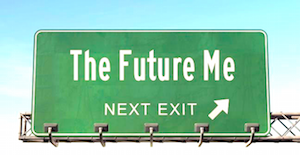 In her classes with CEOs and management teams, McGonigal asks participants to consider the world 10 years from now and to think through all the details of that time. In doing this, she argues, you begin to understand the positive changes that are possible and also bring a distant future into sharper focus so you can help shape it.
This future-centric approach also made me think of professional athletes who talk about “envisioning” a game or race. While I’m not particularly athletic myself and haven’t tried to visualize a win, I have tried to imagine how a presentation will go, including questions that I’ll be asked. Inevitably, I feel better after my visualization exercise…more prepared for what’s ahead.
The possibility I see in this mental time travel paradigm is that if we can teach kids to think about their futures with more specificity and positivity, then we can have a significant impact on not only their self-image but their well-being. Helping to foster a stronger sense of well-being is critical work in our anxiety-ridden, social media-saturated times.
What classroom time travel can look like
If you’re with me so far, you might be asking, okay, lady, exactly how do we teach kids to think about their futures with more positivity? Luckily, there are evidence-based protocols that already exist in the field of positive psychology that we can incorporate into our classroom practices.
Here are a few ways I’ll bring good future vibes to my students:
► “Me at my best”: Ask students to write about a time when they were or would be (time travel) at their best. The description should be as detailed as possible and include elements like the weather, the general environment (i.e., school, home, the art studio, the track field), what the student is doing, what they hear, smell, and feel, and who else is around. What is the student’s internal state?
After writing this paragraph, ask students to share. Then ask them to consider how they can make this day happen, tomorrow. What would be required? Have them explain out loud, then encourage them to make tomorrow a day when they’re at their best.
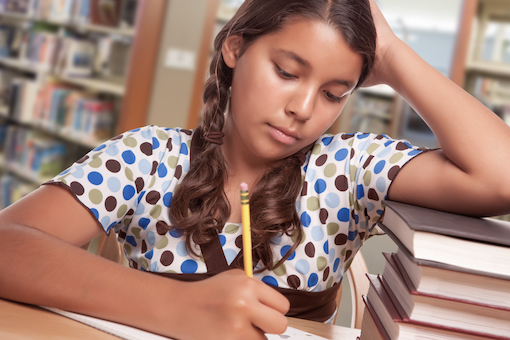
► For those students who don’t like the “me at my best” prompt, ask them instead to consider their ideal day. What would the ideal day involve? Who would be there and what would happen? How would that day look, sound, taste, and feel? Have them write a detailed account, then share. As above, then ask what it would take to make that day happen? Could they make parts of their ideal day occur this weekend?
► Inspired by Jane McGonigal’s work, ask students to imagine a day 10 years in the future. Then, have them build or draw their living space in that imagined future. What would be in their homes that is the same as what they have now, and what would be different? How would changes in the world be reflected in their personal spaces?
As an example, teenagers in 2006 had cell phones, but most homes in the US also had landlines. By 2016, smartphones largely replaced landlines in US homes. What future innovations might have that kind of impact on students’ future selves?
► Gratitude is a well-known path to improved well-being, but often we think of gratitude as a mental time travel to the past: we think about the kindnesses we’ve received and express gratitude for them. We can stoke future gratitude by anticipating joys yet to come.
Ask your students to imagine a future time, like their birthday, or the end of the school year, or the end of a performance of some sort. Have them envision the scene and its accompanying details. Then ask, what are you grateful for in that moment? Who has helped you get there? How might you express your gratitude?
As adults, we know that 70% of the fun of a vacation is the anticipation of it. In this scenario, we’re flooding students with gratitude for the joy of what’s to come…an accomplishment, an ending, or a celebration.
Mental time travel across the curriculum
I realize you’re probably busy teaching other content and skills and that this positive mental time travel business takes minutes away from important math concepts and history lessons. I get it! Simply use the activities as a hook into a larger lesson.
For example, let’s say you’re teaching the Constitution as a part of your American history class. The founders of our country clearly had to imagine 10 years into the future to write a Constitution; indeed, they had to forecast even further out than that! The living space activity I described above helps students empathize with those founders and the analogy is clear: writing a Constitution requires positive mental time travel just like building a future living space does.
Math teachers may ask students to do the gratitude activity before a math assessment:
“Imagine what it will feel like to be finished with this test, having done your best. Might you even express gratitude to yourself for preparing so thoroughly?”
A force for good
While time travel seems like an idea that firmly belongs in the realm of science fiction, I encourage you to think of it instead as an act of imagination that helps students understand how to be a force for good in their own lives and the lives of others. Intentionally incorporating positive mental time travel into your lessons can improve students’ sense of well-being, thereby increasing their focus and regulation.
Joyful learning!
Works Cited
McGonigal, Jane. Imaginable. Spiegel + Grau, 2022.
Wang Q, Koh J B. “How will things be the next time? Self in the construction of future events among school-aged children.” Conscious Cogn. 2015 Nov; 36:131-8. doi: 10.1016/j.concog.2015.06.013. Epub 2015 Jul 1.
 Stephanie Farley has been an English teacher and independent school administrator in southern California for 27 years. Now Director of Teaching and Learning at a school for gifted, neurodiverse students, in fall 2024 she will be working with grades 4-12 teachers and teaching ninth grade English. Stephanie, who is interested in instructional design, assessment, feedback, and grading, has served as a Mastery Transcript Consortium Site Director and has been on a number of California Association of Independent Schools accreditation committees.
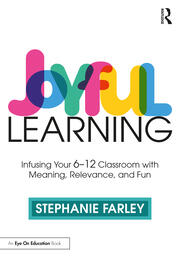
Stephanie’s first book is Joyful Learning: Tools to Infuse Your 6-12 Classroom with Meaning, Relevance, and Fun (Routledge/Eye On Education, 2023). She has created professional development for schools around reading and curriculum and has coached teachers in instruction, lesson planning, feedback, and assessment. Visit her website Joyful Learning and find her other MiddleWeb articles here.