
Analyzing the Media Through Docudramas
 By Frank W. Baker
What makes movies about the media so appealing? For as long as there have been movies, the media and the subjects they cover have been popular Hollywood topics. And why not: many of us pay attention not only to the news but also to the media themselves.
 What do these movies, past and present, have in common? They’re all docudramas. They are not documentaries and they are not true dramas. The docudrama borrows from both genres.
Do your students know that when they watch docudramas, they’re not watching history as it actually happened? Do they understand the “artistic license” that movie makers utilize when they contract to take an historical event and condense it into a two-hour film?
These movies are not just for the journalism classroom. Every teacher who is concerned about the past, present and future of the media could use these films as teachable moments.
What follows is not an exhaustive list, but it nonetheless includes some noteworthy movies with media as the central focus:
 Network (1976) A network anchorman complains about the trivialization of news and starts to lose his hold on reality. (Who can forget the anchorman’s proclamation: “I’m mad as hell and I’m not going to take this anymore!”)
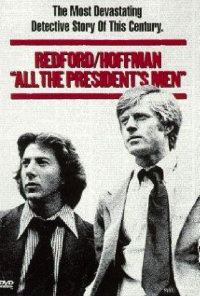
All The President’s Men (1976) followed Washington Post reporters (portrayed by Robert Redford and Dustin Hoffman) as they investigated the Watergate break-in and how their subsequent stories led to the resignation of President Nixon.
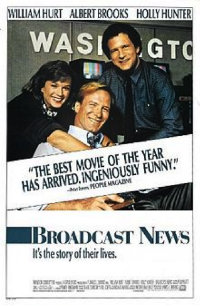
Broadcast News (1987): a film that critic Roger Ebert wrote was as “knowledgeable about the TV news-gathering process as any movie ever made.”
Quiz Show (1994) profiled the early TV quiz show scandal that led to a Congressional investigation.
 The Insider (1999) told a story of former tobacco executive Jeffrey Wigand (played by Russell Crowe) who is courted by CBS’s 60 Minutes to make public Big Tobacco’s secrets. The movie drew on on 1996 article that appeared in Vanity Fair.
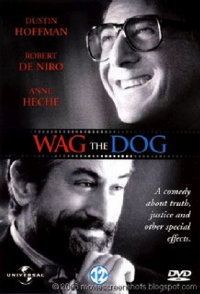
Wag The Dog (1997) profiled consultants who whip up fake news in order to cover up a presidential candidate’s sex scandal.
Good Night & Good Luck (2005): George Clooney’s tribute to broadcast journalist Edward R. Murrow as the CBS reporter challenged Senator Joseph McCarthy’s Communist witch-hunt techniques.
The Social Network (2010) portrayed the birth, struggle and development of Facebook as the new social media platform.
Nightcrawler (2014) follows a news cameraman (Jake Gyllenhal) as he works the night shift to photograph news, often crossing ethical boundaries, to help his employer get higher ratings in the highly competitive Los Angeles TV news market.
 The year 2015 was a banner year for movies with media figures and organizations as their central theme.
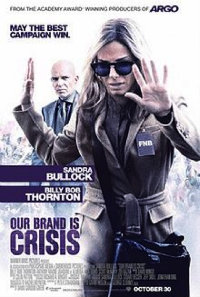
Our Brand Is Crisis is a 2015 drama featuring Sandra Bullock as a political media consultant who finds it challenging to try to transform the image of a candidate running for president of Bolivia.
Truth (2015) stars Robert Redford as CBS journalist Dan Rather who in 2008 challenged 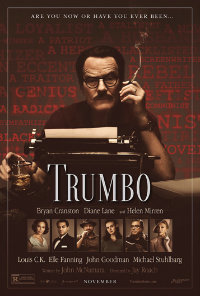 President George W. Bush’s National Guard service record but whose reputation (and that of his producer) were damaged by the use of questionable sources.
Spotlight (2015) profiles Boston Globe journalists as they pursued allegations of sexual abuse by Catholic church clergy.
Trumbo (2015) is a film starring Bryan Cranston as Dalton Trumbo, the Hollywood screenwriter who was blacklisted as part of the McCarthy-era communist witch hunts and wrote under pseudonyms or without credit from the late 1940s until the early 1960s.
Implications for The Classroom
As I have written in this space previously, Common Core middle grade ELA standards make specific references to the techniques used in making movies, as well as the decisions made by directors and actors.
 Whether it’s an English teacher using a Shakespeare film or a history teacher using a docudrama, all students need to understand and appreciate the decisions and techniques movie-makers use when they create compelling stories on film. Ask students to consider how a particular film or scene might have been altered to make a subject or person appear better on screen.
Teachers who use films about the media might want to first have their students conduct background research into the facts behind the media or media event. It’s a no-brainer to locate reliable information, for example, about the Washington Post’s role in reporting on the Watergate scandal. Students could investigate if a particular film scene (e.g. Watergate reporters meeting a secret source in a parking garage) is portrayed accurately.
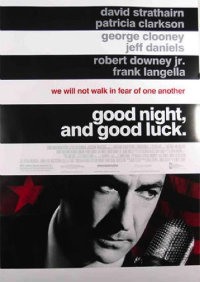 For the release of “Good Night and Good Luck,” FilmEducation.org produced this film study guide designed to help students dig deeper into Murrow, McCarthy and the issues the film addresses. RTNDA, the Radio TV News Director’s Association, also produced a study guide – excerpts can be found here.
For every film that is released “based on true events” there are plenty of legitimate news stories, blog posts, or social media postings that attempt to pull back the curtain on what the filmmakers got right and what they might have altered and why. (Last year, I wrote about this topic.) Challenge your students to find news sources that are pulling back the curtain on the current crop of docudramas.
Teachers don’t have to wait for the film to be released: they can use the film’s trailer to familiarize students with the narrative, characters, conflict and more. I’ve created this web site with advice and resources for teaching trailers as persuasive texts. (Here’s one example of a trailer – for The Insider.)
Each film’s poster also can be considered an “informational text” with specific visual and textual features. Ask students to consider what quintessential information must be included in a film’s poster. Task them with re-creating the poster.
In summary, docudramas can be an effective medium in both ELA and Social Studies classes to explore many areas of curriculum, including creative and persuasive writing, current events, historical perspectives, and filmmaking itself.
Resource:
► In this March 2000 archived interview clip, former tobacco industry executive Dr. Jeffrey Wigand, the central character in The Insider, discusses the film’s accuracy.
Frank W. Baker is a media literacy education consultant and the author of three books, including Media Literacy in the K-12 Classroom (ISTE, 2012). He contributed two chapters to Mastering Media Literacy (Solution Tree, 2014). He is a recipient of the National Telemedia Council‘s annual Jessie McCanse Award given for individual contributions to the field of media literacy over at least 10 years. Follow him on Twitter @fbaker and visit his resource-rich website Media Literacy Clearinghouse.










Fascinating story (When The Truth Ends Up On The Editing Room Floor) in the Boston paper, regarding a character portrayed in Spotlight. http://www.bostonglobe.com/metro/2015/11/21/when-truth-ends-editing-room-floor/a80DjFtwNj5CQfu6WuFBLL/story.html?event=event25