
Why Kids Need to Talk in Math Class
(and How to Make Discussions Actually Work)

By Mona Iehl
It’s December, so the sun sets before dismissal here in Illinois. Half the class is wearing hoodies pulled so low you can barely see their eyebrows.
No matter the prompt, it’s the same six or seven students raising their hands like muscle memory. On a good day, maybe ten…while the rest of the class sits back and waits for someone else to answer.
And this is where many math teachers start wondering, “Is math talk even worth it?”
When math discussions feel unproductive or unpredictable, it’s tempting to slide back into the familiar routine: teacher asks, students answer. It feels efficient. It feels safe. But it’s not a math discussion.
Here’s the key truth: Kids don’t learn math by listening to us solve problems. They learn math by talking about how THEY solve problems.
Math education research has said this for years. Students deepen understanding when they articulate thinking, listen to peers, revise ideas, and make sense of strategies beyond their own. Talk is not an extra. It’s the engine.
So the real challenge becomes: How do we make math discussions productive instead of painful? Let’s break this into three simple shifts.
1. Kids need regular talk time to learn how to talk about math.
When I moved from 3rd to 5th and 6th grade, I hit a wall. My older students were pros at hiding. The “math kids” handled all the talking. Everyone else vanished behind hoodies and silence.
But I knew if I wanted them to truly understand multi-step problems and feel confident, I needed everyone engaged. Not just the volunteers. So I borrowed from my 3rd-grade playbook and made one big change:
We sat in a circle. Every day.
I kept the talk routines simple:
- Turn and talks
- “I notice…” and “I wonder…”
- Nonverbal signals
- Revoicing
And I gave them one expectation: “All you have to do is participate, listen, and think.”
Low pressure, but high expectations for belonging in our math community.
Slowly, the shift happened. Students came to expect discussion. They contributed more. They listened more. They took risks because the structure was predictable and safe.
Kids don’t become confident math thinkers by accident. They grow into it through daily opportunities to practice discussing their thinking and listening to the perspective of others.
2. Discussions become meaningful when you plan for how students might solve.
This is the part teachers rarely admit out loud, but almost all of us feel:
- “I never know what to ask next.”
- “What if the discussion goes nowhere?”
- “What if a student says something unexpected and I freeze?”
This uncertainty is exactly why planning for discussion matters.
And no, that doesn’t mean scripting. It means forecasting.
Forecasting is sitting with the task ahead of time, like a multi-step word problem, and exploring several ways students might approach it. Not predicting the exact moves, but outlining possible strategies so you’re familiar with the math in each strategy or model.
This is what helped Mr. Walt.
His students answered questions just fine. A handful of hands always shot up, but he knew most students weren’t listening or engaging deeply. Open-ended prompts made him nervous. He liked structure. He liked predictable responses.
After learning how to forecast, he tried something different.
He asked himself:
- How might students break the problem apart?
- Who might draw a diagram?
- Who might jump straight to the algorithm?
- What misconceptions are likely?
- Where could strategies connect?
This gave him a map that was flexible, not fixed.
When he launched the discussion, he pushed himself to talk less and let student ideas drive the conversation. And what happened surprised him:
The discussion didn’t derail. Students made connections he hadn’t planned. He wasn’t nervous. He was proud.
When teachers understand the landscape of potential strategies, they feel confident navigating whatever students bring up in the math discussion.
3. Keep it simple. Predictable routines create deeper learning than adding more content.
There’s a myth that productive math talk requires more problems, more questions, and more elaborate planning. However, sustainable math discourse relies on simplicity and predictability.
You only need:
-
- A clear learning goal
- An aligned task
- A forecast of likely strategies
- A sense of where the connections live among the strategies
When the structure stays steady, students go deeper because they’re not guessing what’s coming next. And you can go deeper because you aren’t scrambling for questions in the moment.
Predictability creates room for thinking. When students talk, they learn. And when teachers have a simple plan, discussions become the most powerful part of the math lesson.
Give it a try and let me know how it goes. In my new book (see below) I include a simple structure that makes math discussions feel doable, including a practical discussion-flow tool to use every day, a forecasting guide to help plan for multiple strategies, and a predictable routine that helps students talk, think, and make connections.
If you want a quick boost right now, download my free resource: 35 Questions to Ask in Math Class.
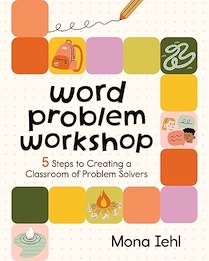 Mona Iehl is an elementary and intermediate grades educator who transformed her approach to teaching math by embracing student-centered methods that foster curiosity and engagement. She has captured her process in her new book, Word Problem Workshop: 5 Steps to Creating a Classroom of Problem Solvers (Routledge/Stenhouse, 2025). Mona now coaches educators to create inclusive math classrooms where all students develop deep, lasting problem-solving skills. Follow her Math Chat Podcast and connect with her online @HelloMonaMath. Read her other MiddleWeb articles here.

















Thank you, I am going to try them with my next math lesson. Keep it simple really makes sense.
Great!! I’d love to hear how it goes.
What would happen if you didn’t give them the whole problem? What would happen if you just gave them the setup? And then ask them to predict all the possible paths, the next part of the problem might take and them author all sorts of new possible problems and let each other solve them? Wouuld that work?
Interesting idea! Definitely give it a try & see how it goes. Keep me posted, I’m curious how students will respond!!