
Social Studies Data: Make ’em Graph It
A MiddleWeb Blog
 Teaching students to read and understand different charts and graphs often feels like a chore for all parties involved. This is especially true if – as is the case at my school – a sizeable percentage of the students do not understand basic arithmetic.
This mathematical deficit can turn a helpful visual comparing the relative industrial outputs of the Union and Confederacy during the Civil War into a complicating factor that further obfuscates already complex historical events.
While I cannot claim to have completely mastered the art of making graphs comprehensible to all students, my students recently completed a comparison project that appears to have created a solid foundation on which I can continue to build throughout the school year.
Designing a survey
 My students recently completed a research project revolving around a social issue of their choosing. The last part of this project involved a student-generated survey. Working in teams, students created three questions: one yes-or-no question, one multiple-choice question, and one open-ended question. Each team member was required to conduct a minimum number of surveys, such that each team would have enough data (20-30 responses) from which to create a few simple graphs.
Organizing the data
After completing their surveys, student teams pooled the responses. The yes-or-no and multiple-choice questions simply needed to be counted. The open-ended questions, however, required more thought. After showing the whole class how teams might group their open-ended responses, I worked my way around the room to help individual teams accomplish this task. Usually, I encouraged teams to create no more than four categories of similar responses, with an “other” category for the outliers.
The most important part of this exercise is that students create categories that make sense to them, and that narrative responses are transformed into discrete, countable units.
Making the graphs
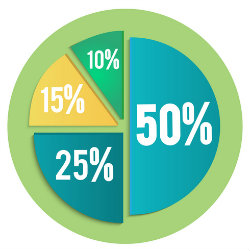
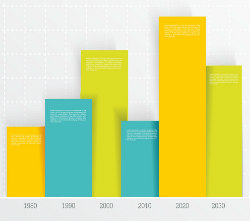 Finally, each team was responsible for the creation of three graphs. The yes-or-no questions became bar graphs, comparing the total number of yes’s and no’s. The multiple choice questions became pie charts which showed the percentage of responses for each possible answer. Finally, I allowed the students to choose the graph they would use to represent the answers to the open-ended questions. The original plan was to have students use this data to create infographics, but time constraints made this impractical. (It might be more practical for others.)
As the students were making their rough draft graphs, it became clear which teams understood the basic mathematical principles required to accurately represent data, and who needed help. I was able to target those teams whose graphs did not match the survey data they had collected. The misunderstandings varied from student to student, so the targeted approach was ideal with my population.
Some broader applications
 I had originally planned for this to be an inter-curricular project. The science department at my school was even covering graphs at the same time. However, for a variety of reasons, the project remained entirely in my classroom. To my mind, this is far from ideal. Transference of skills from one class to the next is a major struggle for my students, and this would have been an ideal opportunity to help them connect concepts covered in math, science, history and English.
Even without the cross-curricular connections, I believe having the students create their own graphs from data they collected helped to make the whole notion of graph reading a little less abstract. As the year progresses, I will refer back to their graphs as we look at historical data, and my hope is that they are able to see the story behind the shaded rectangles and colored wedges.





















Aaron I would like to get in touch