
Gallagher: Students Need Worthy Writing Models
A MiddleWeb Book Excerpt
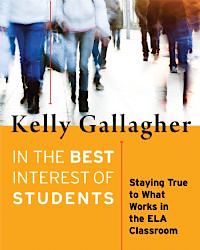 Kelly Gallagher’s In the Best Interest of Students: Staying True to What Works in the ELA Classroom (Stenhouse 2015) is not precisely a sequel to his highly praised 2009 critique of literacy learning in the NCLB era, Readicide: How Schools Are Killing Reading and What You Can Do About It. But it is certainly a follow-up, written in response to the dramatic changes in literacy education triggered by the Common Core State Standards.
Gallagher’s approach in his new book is to consider both the strengths and shortcomings of the Common Core ELA anchor standards, based on research and best practice that he believes will best serve young learners. His call to action ends Chapter 1:
Let’s step away from the politics and madness that have accompanied yet another new educational movement. Let’s step away from the pendulum that has swung once again. Let’s step away from teaching to another series of tests that narrow our instruction. Instead, let’s direct our focus on what we know works when it comes to teaching students how to read, write, listen, and speak. Let’s focus on what is in the best interest of students.
Gallagher then devotes two chapters each to the reading and writing anchor standards. Next, in Chapter 6, he looks at “Using Models to Elevate Our Students’ Reading and Writing Abilities.” Gallagher urges teachers to
make sure we provide our students with plenty of opportunities to stand next to worthy models of reading and writing… Amongst all the noise currently surrounding the new standards and testing, let’s not forget that building better readers and writers often begins with finding good models for our students to emulate.
Chapter 7 reflects on another Common Core focus, “Sharpening Our Students’ Listening and Speaking Skills.” Gallagher then summarizes his perspectives in the final chapter, “Shift Happens.”
Although Gallagher never strays from his advocacy message (teachers are obliged “to stay true to what works”), the book is full of actionable teaching ideas and examples, many drawn from his own classroom. In choosing an excerpt to share with MiddleWeb readers, our goal has been to isolate 1200 words that both demonstrate his advocacy and offer immediate, helpful ideas to teachers.
Our selection comes from Chapter 6. (For more on Gallagher’s CCSS perspective, preview the book at the Stenhouse site.) – John Norton, MiddleWeb co-editor
Why Students Need Models Across the Writing Process
 by Kelly Gallagher
In the 1964 World Series between the New York Yankees and the St. Louis Cardinals, some of the Cardinals players noticed that Yankee outfielder Tom Tresh had a slight limp as he ran out to his position in left field.
“Does he have a bum knee?” someone asked.
“No,” replied third baseman Ken Boyer. “He runs like that because that’s the way (Mickey) Mantle runs” (Halberstam 1994, 323). This form of emulation amongst ballplayers is not uncommon, notes Tim McCarver, Cardinal catcher and Hall of Famer.
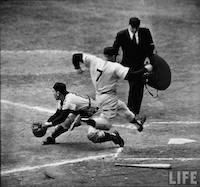 McCarver often noticed that “young players, consciously or unconsciously, tended to take on the mannerisms of the best players of their teams” (Halberstam 1994, 323). There is no mystery as to why they did this: Aspiring young players study the superstars in hope of discovering the magic ingredients that fuel their amazing feats—from how they carry themselves to the way they swing the bat. After all, there’s no better model for success than those who are successful.
It’s not my job to teach my students how to play baseball, but if it were, I’d want them to run (and hit) like Mickey Mantle, too. Instead, my job is to build young readers and writers, which is why I want them to consciously and unconsciously emulate the mannerisms of the Mickey Mantles of adolescent literacy—the John Greens, the Laurie Halse Andersons, the Chris Crutchers. Providing models for emulative purposes is critical to deepening my students’ ability to read and write.
Models Matter in the Teaching of Writing
To show my students the importance of models, I begin by distributing a blank sheet of paper to everyone in the class. I tell them that I am going to name an item and that I want them to draw it to the best of their abilities. When they are ready, I write “Kakapo” on the board and tell them to begin. Without fail, they ask, “What is a Kakapo?” I tell them that if they don’t know what it is, they should guess what it might be and to begin drawing what they think it might look like.
 Students come up with some unique creations. After some sharing (and some laughter), I show them a photograph of an actual Kakapo, which is a flightless member of the parrot family with a greenish-yellow underbelly, a broad head, a large bill, and an owl-like circular facial disk (BirdLife International 2014). Of course, their original drawings are inaccurate, so after they have looked at the photograph for a few seconds, I remove it and then give them two minutes to revise their drawings. Immediately, their drawings improve. The point of the lesson? To draw a Kakapo, one must know what a Kakapo looks like. This lesson helps them to internalize the importance of having a model at their sides.
I am not charged with teaching my students how to draw birds, but I am charged with teaching them how to read and write better. Instead of photos of Kakapos, they need lots of models of exemplary writing. If we want our students to write compelling arguments, or interesting explanatory pieces, or engaging narratives, we need to have our students read, analyze, and emulate compelling arguments, interesting explanatory pieces, and engaging narratives. Before they begin writing, they need to know what the writing task at hand looks like.
Models Help Young Writers
When it comes to the teaching of writing, effective modeling entails much more than handing students a mentor text and asking them to emulate it. It is not a “one and done” process.
 Rather, students benefit when they pay close attention to models before they begin drafting, they benefit when they pay close attention to models while they are drafting, and they benefit when they pay close attention to models as they begin moving their drafts into revision.
Mentor texts achieve maximum effectiveness when students frequently revisit them throughout the writing process. Let’s explore the value of modeling in each of these stages.
Modeling in the Prewriting Stage
If we want our students to write in a particular discourse, such as poetry, then we should begin by providing them with lots of poems to read. As students are swimming in poems, we must move beyond simply asking them to retell what the poems say; to maximize the effectiveness of the models, students need to be taught how to read like writers—how to notice the techniques, the moves, and the choices the poets make.
Students are accustomed to being asked what is written, but asking them to recognize how the text is written is a different kind of reading than many of them are accustomed to. This shift—from what something says to how it is said—is seen in three of the ten Common Core anchor reading standards on Craft and Structure (CCRA.R.4, 5 & 6).
All three of these standards ask readers to answer the same basic question: What did the writer do? To get my students to begin thinking in these terms, I start them with “Four Skinny Trees,” a vignette from Sandra Cisneros’s The House on Mango Street:
 They are the only ones who understand me. I am the only one who understands them. Four skinny trees with skinny necks and pointy elbows like mine. Four who do not belong here but are here. Four raggedy excuses planted by the city. From our room we can hear them, but Nenny just sleeps and doesn’t appreciate these things. Their strength is secret. They send ferocious roots beneath the ground. They grow up and they grow down and grab the earth between their hairy toes and bite the sky with violent teeth and never quit their anger. This is how they keep. Let one forget his reason for being, they’d all droop like tulips in a glass, each with their arms around the other. Keep, keep, keep, trees say when I sleep. They teach. When I am too sad and too skinny to keep keeping, when I am a tiny thing against so many bricks, then it is I look at trees. When there is nothing left to look at on this street. Four who grew despite concrete. Four who reach and do not forget to reach. Four whose only reason is to be and be. (1991, 74)
After reading this passage, students are asked to identify the techniques employed by Cisneros. For example, I want them to recognize how she employs personification (“Four skinny trees with skinny necks and pointy elbows like mine”), how she uses similes (“they’d all droop like tulips in a glass”), how she uses intentional repetition (“Four who . . . Four who . . . Four whose . . .”), and how she stacks the end of the passage with a series of intentional fragments. I also want them to understand that she uses four skinny trees as a central metaphor for the struggle of growing up in poverty.
Having students recognize these techniques before they begin writing helps students adopt these techniques when they get to the drafting stage.
[Gallagher continues with a discussion of modeling in the drafting and revisions stages and the use of mentor sentences. The second half of the chapter explores reading models.]
Read a review of In the Best Interest of Students here at MiddleWeb.
Kelly Gallagher is a veteran secondary school ELA teacher, literacy consultant, and the author of six books about aspects of teaching, including Reading Reasons: Motivational Mini-Lessons for Middle & High School; Deeper Reading: Comprehending Challenging Texts, Grades 4-12, and Write Like This: Teaching Real-World Writing Through Modeling and Mentor Texts. He currently teaches at Magnolia High School in Anaheim, California.














thanks for all these valuable resources.