5 Surefire Ways to Get Students to Talk in Class
 By Marilyn Pryle
Have you ever had this experience? Your students have read a text, and you are sure that they have some opinions, questions, and observations. But when you ask them what they think, the majority of them remain silent and the ones who raise their hands say something like “It was good” or “I didn’t like it.”
If you’re like me, you then embark on a long journey of “whys” — Why was it good? Why didn’t you like it? Why was the ending sad? Why didn’t it make sense? Why was that character funny? And so on.
With enough nudging, a student may point to something in the actual text. The students who don’t want to speak up remain silent, or say “I don’t know” when called upon.
After years of feeling like my students could do better, and feeling like I wasn’t hearing from enough of them, I devised a system of reading response writing that requires students to craft brief, specific, cited thoughts about a text. I wrote about it last fall, and I encourage you to read that article for a detailed explanation of the technique. Here, I’ll just recap the four basic rules for writing a Reading Response:
The Four Rules
1. Choose a category of response, using the list of possible categories, and write the category name at the top of the response.
2. Develop an original thought within that category and write out the thought.
3. Find, copy, and cite a line, paragraph, or page from the text that relates to the original thought.
4. Keep writing and thinking for at least five sentences.
In my September MiddleWeb post, I explained the concept of categories and gave examples of some of the most popular ones: Give an Opinion, Make a Connection, Language Recognition, Mark the Motivation, and What Would__Say?
Here are five more popular categories and their accompanying prompts. I’ve included teacher notes and student examples to illustrate.
1. Ask a Question
Write a specific question. This can be a question about something you don’t understand in the text, or a larger question (about life, literature or anything) that the text made you consider. Remember, you must still write five sentences – you can do this by explaining what you understand so far before asking the question, or by trying to answer your question after you ask it.
In this category, the question itself qualifies as the original thought. This category gives students permission to not know, to wonder, to guess. The fact that it “counts” as much as every other category communicates the importance of not knowing to students. It also sets the stage for interesting and productive discussion.
Ask a Question for The Maze Runner (J. Dashner) – Hannah’s response
 The situation in the book The Maze Runner made me ask myself a question: What if everything that happened in the book happened in real life? What if all of a sudden we found ourselves in a strange place with no memory? How would that make us feel? “That…was the only thing he could remember about his life. He didn’t understand how this could be possible. His mind functioned without flaw, trying to calculate his surroundings and predicament,” (pg. 1). I would feel scared and worrisome. Also, I would probably get a headache all the time from trying to remember stuff.
2. Spot the Setting
You notice a part that refers to the place or time of the story or poem. Why is it important? How does it relate to the theme, characters, or plot?
Students are asked to view setting as a deliberate choice by an author that serves a larger purpose. They are nudged to ask, “Why this setting, as opposed to another?” I tell students: Always question the setting. What purpose does it serve? How is it symbolic? How does it help the author tell the story?
Spot the Setting for The Hunger Games (S. Collins) – Dilan’s response
 The tributes (players) have to wait a week to see the environment they’ll be fighting on. Then, in 60 seconds, tributes see the environment and immediately have to know what to do. That’s what it feels like for Katniss. Over the last week she’s been wondering where she will play the Hunger Games. Then, in 60 seconds it’s a lot for her to process what to do. For instance, she says, “We are on a plain, flat, open stitch of ground. A plain of hard packed dirt… To my left and back, sparse piney woods. This is where Haymitch would want me to go. Immediately” (pg. 148). This is important because it will be a place where Katniss will have to survive against other tributes. Also, Katniss just figured out that she can use the woods to her advantage in the games. Over a period of time, the woods can make the difference between Katniss living or getting killed.
3. Mind the Mood
You feel the mood of the piece. What is it, and what is creating it (something in the setting? dialogue? plot? sensory details?) Remember that mood is the feeling in the text, not the author’s attitude. Your quote should show evidence of the mood. Then: Why is the author doing this?
This category automatically requires students to make an inference from the text. Mood exists on a subtextual level – it is manifested through other elements, such as setting, plot, or dialogue. Students must tie their inference to a quote, which is important because often readers can feel the mood while reading, but struggle to put a finger on what, exactly, is creating the mood.
Mind the Mood for The Iliad (Homer) – Keena’s response
 The mood from Book 1 is very hostile and angry. What makes the text so angry and hostile is an argument between Agamemnon and Achilles. Now, we already know that both men hate each other with a burning passion, which only adds to the piece. In the story Agamemnon says, “You—I hate you most of all the warlords loved by the Gods” (pg 371). Achilles then responded to Agamemnon by drawing his sword. It wasn’t until the Goddesses Hera and Athena intervened and stopped the two enemies from acting so childish. But even after the goddesses left they continued to argue but no swords were drawn because they would not dare go against the words of the Goddesses.
4. Sensing a Symbol
You notice an object or detail (in nature or human-made) that seems to mean something deeper. What is it and what is it doing? Have you seen it before in the text? What could it mean? What theme or character could it point to? Why do you think this?
Students enjoy recognizing symbols because they feel like they’re in on the author’s secret messaging, but it takes practice. Students should look closely at details such as objects, landscapes, weather, and sounds, and question everything. Keep reminding students to ask themselves, “Does it mean something deeper?”
Sensing a Symbol for Walk Two Moons (S. Creech) – Sabrina’s response
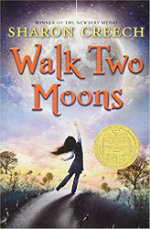 “She kept climbing and climbing. It was a thumpingly tall ladder. She couldn’t see me, and she just never came down. She just kept going” (p. 162). In this chapter Sal has a dream where her mother is climbing a ladder. She doesn’t come down or even look at Sal. She just keeps climbing. This is symbolic of Sal’s mom leaving and not coming back. This idea is the main conflict that the whole book is about. We don’t know what happened to Sal’s mom right now but the main conflict must be solved.
5. Theme Recognition
Find a sentence or two that might connect to a theme (the message) of the piece. Tell the theme, and explain how that portion of text relates to it.
The one-word summaries we give to overall themes – ideas such as “survival” or “growing up” – are subtly nuanced and layered in a well-written text. For this reason, asking students to find evidence of a theme in an actual line or two for their Reading Responses is an important practice.
Theme Recognition for “The Story of Daedalus and Icarus” (Ovid) – Krutik’s respone
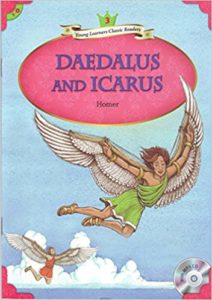 In “The Story of Daedalus and Icarus,” Daedalus (dad) makes wings for his son (Icarus) and instructs him to not go too high nor too low. The father instructs the son very carefully but Icarus got lost in what he was doing. During the flight he becomes overconfident and flies too high and the wax on the wings melts and he falls down into the water. “And the boy thought This is wonderful! and left his father, soared higher, higher, drawn to the vast heaven, nearer the sun, and the wax that held the wings melted in the fierce heat…until the blue sea hushed him” (lines 48-55). He becomes too overconfident and falls into the sea. The theme of the story is that overconfidence could result in critical consequences.
Result: Transformed Classroom Discussions
With Reading Responses, students have the tools to slice into a text and formulate specific thoughts backed with cited evidence. It transformed my classroom discussion. Instead of surface-level, nebulous, tentative guesses from a few students, we now have sophisticated, detailed conversations that draw the whole class in.
 Marilyn Pryle (@MPryle) is a National Board Certified teacher in Clarks Summit, PA and has taught middle and high school English for over twenty years. She is the author of several books about teaching reading and writing, including 50 Common Core Reading Response Activities and Writing Workshop in Middle School. Marilyn is the 2019 Pennsylvania Teacher of the Year.
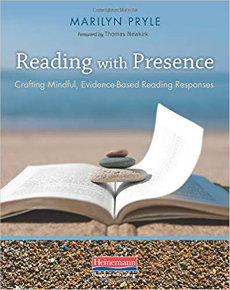
This article is adapted from Marilyn’s new book Reading with Presence: Crafting Meaningful, Evidenced-Based Reading Responses (Heinemann, 2018). Learn more about Marilyn at marilynpryle.com and read other articles she’s written for MiddleWeb here.