What Matters Most for Co-teaching Success
A MiddleWeb Blog
 The beginning of any school year naturally becomes a great kaleidoscope of emotions, responsibilities, and experiences. Co-teachers become engulfed in the range and depth of balancing it all, which is not always an easy task.
I’m reminded of one co-teacher I partnered with so many years ago. She and I worked hard to keep the lines of communication open between us to ensure a two-teacher team approach to everything we did with our students.
One morning she came in particularly relaxed (something I was not used to!). I joked and asked her “Who are you? And what have you done with my co-teacher?”
The relaxed tone was a refreshing change that she attributed to our ongoing communications—and to a mantra that she woke up reciting that morning. She said that in its simplicity she found the power to guide her focus. And she vowed that she would embrace it each co-teaching day.
Her newfound mantra: Remember the important thing is to remember the important thing. She typed it up, wrote it down, sketched it out, and placed the statement strategically in a variety of visible places — her planbook, on her desk, on the file cabinet, any place she felt she would need this simple, gentle, and necessary reminder.
Being me, I saw the opportunity to stretch this out into a world of communicative possibilities. I asked her…So what is your important thing?
This became a conversation between us that lasted the school year. And here in this post I will offer the essence of what she and I shared together, in hopes it will inspire strong communication, care, and collaborations in your co-teaching relationship.

The following is a summary that paraphrases some key ideas my co-teacher and I generated while focusing on her mantra. I share it with you now in three easy-to-remember ways so you may deepen your experiences.
Listening
Make sure you listen (not just hear) what your co-teacher feels and thinks each day. Yes, you heard right…each day! This becomes an organic—naturally embedded—practice. However, at first, it may be something you may need to make additional time to do. For example, my co-teacher and I made sure to meet in the classroom at least one morning a week. By the end of the school year, this naturally evolved into three times a week!
If you don’t have any additional time to spare (that is a true reality!), then just make sure to add these response statements throughout the day. How do you feel about…, I am thinking…., what did you think about that? It comes down to the basics of care. When you care – on a truly human level – you will automatically wonder what your co-teacher is thinking.
 This listening practice will flow into all aspects of your co-teaching day and life! The students will feel the synergy, and the two of you will serve as top notch role models for them as they interact with peers in the classroom – and ideally throughout life. In addition, any administrator will surely notice the power of two minds working together as one.
Listening – truly listening and caring – takes on a ripple effect of its own. In fact, I believe it becomes the core foundational rock that anchors everything necessary for strong, successful co-teaching experiences. Check out these resources from ThoughtCo. for deeply understanding the value of listening. Here’s additional information on how your co-teaching active listening practices may empower your students—quite possibly for life (no exaggeration there!).
Teaming
Once caring, active listening takes root, you are going to love what happens next! Eventually, simultaneously with listening comes an organic stance of two teachers teaming up to plan, implement, and assess classroom experiences. I dare say, the better you are at embracing active listening, the easier this important “co-teaching thing” comes to life.
 So, what does it look like? Picture this. One teacher is in charge of the lesson, and the other teacher chimes in to clarify – to summarize or to model note-taking.
The teacher in charge is not always the same teacher. However, as long as both teachers are actively expressing their personal expertise in the process of learning – that IS the teaming process coming to life. For more ideas on valuing the expertise of both teachers check out my book Elevating Co-Teaching through UDL (published by CAST).
And be sure to come back to leave a comment or ask a question, and let’s keep our learning flowing. I am here and ready when you are!
Extending
Hopefully by now you are feeling some sort of flow that centers around what is important for successful co-teaching. If so, you see (and hopefully feel) that the core of what the important co-teaching thing is begins with listening. At least that is the case for my story here. This meaningful listening naturally flows into teaming up. And teaming up means that each co-teacher will become a better version of themselves – simply by having the care and support of the other.
This sense of the “co-teaching self” is embraced as each co-teacher feels heard. As lessons are planned, make sure that each of you has an active role in the instructional process. That means that each co-teacher will surely experience a stepping beyond their comfort zone: learning new content, learning new strategies, teaching in new ways that could not have been possible without your co-teaching partner.
And oh! How glorious is that?
______________________________
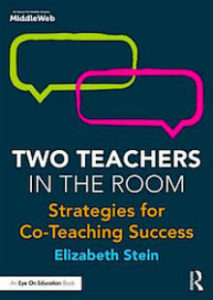 Elizabeth Stein’s Two Teachers in the Room which provides a wealth of practical strategies and tips to help K–12 educators co-teach more effectively and 2024’s The Co-Teaching Power Zone: A Framework for Effective Relationships and Instruction.