
Be a Shade of Gray in the Either/Or Math War
Our 6-12 students who struggle with mathematics need us to stop taking sides in the inquiry vs. explicit instruction debate.
By Juliana Tapper
 In my first year of teaching, I snagged a corner classroom at a high school in South Central Los Angeles. I was ready to showcase student work, get to know my students, and have a wonderful year together.
I planned to do exactly what I had experienced in my own high school years: warm up, homework review, lecture, worksheet, and assign homework. But let me be honest, it was a train wreck. My classroom was chaos – a sea of hoodies up, earbuds in, and phones out.
While I was attempting to lecture, my students weren’t paying attention, so when I passed out the classwork, they were confused – goofing off was easier than trying math. I felt like a total failure.
That 20 minutes of lecture + 20 minutes of worksheet + 20 minutes of homework model (I’ll call it the 20-20-20 from here on out) that many of us grew up with, wasn’t working for my students with deep math trauma, math anxiety, and years of math failure. I’m going to go out on a limb and bet it’s not working for your middle or high school students either.
The Tension in Today’s Math Classroom
Today math education feels deeply split. On one side, we have traditional, explicit, or direct instruction. I do, we do, you do or 20-20-20. On the other side, we have the newer inquiry based pushes like Building Thinking Classrooms, Illustrative Mathematics, task based curricula, and project based resources.
Math teachers today feel like they have to take sides; you’re either full-on team inquiry or standing firm in explicit instruction. And this tension is challenging for many of us. We grew up experiencing traditional instruction and it worked. Why change it?
Don’t get me wrong: inquiry based models are excellent for many settings and are definitely a goal for math classrooms to aspire to. If I’m totally honest, I even chose my daughter’s elementary school because I was blown away with their thinking classrooms during the prospective kindergarten parents tour.
But there is a missing voice in this debate: the 6-12 teacher standing in front of a class where students haven’t passed a math class since 3rd grade and struggle with the most basic math facts let alone accessing grade level content.
For these students, jumping straight into a pure inquiry model without any explicit instruction first can be paralyzing. When students face complex tasks with deep foundational gaps, their primal brain takes over – they go into fight, flight, freeze, or fawn mode and learning can’t happen there.
Can We Learn to Be Shades of Gray?
Unpopular opinion: We don’t have to choose one extreme – we don’t have to choose to be black or white when it comes to our instructional choices. We can trust ourselves to be shades of gray, picking the strategies that best serve our specific students.
► Shades of gray in a unit: You might kick off a unit with a rich inquiry task to let students explore, then move into explicit lessons to fill gaps and build the confidence needed for more complex tasks later.
► Shades of gray over the year: Start the year with more predictable explicit structure and, as their confidence grows, gradually release into more inquiry based instruction.
But I do have one caveat: When you do use direct instruction, stay clear of the 20-20-20 loop. It has proven ineffective in my own high school math classroom as well as dozens of other classrooms I’ve supported in my work with schools.
Direct Math Instruction Done Well
Whenever you’re tempted to make your plan for the day lecture then worksheet, I want you to sub in my Math Wars Method instead. This method is a form of explicit instruction, but incorporates some benefits of inquiry like empowering students to guide problem-solving and elevating student status by positioning them as the holders of knowledge.
After the pain of my first year of teaching, I knew I needed to try something different and the Math Wars Method was born (named because of my love of Star Wars).
In my second year my students were engaged, they were participating, they were thriving, and I was too. I’ve now shared the Math Wars Method with thousands of teachers and the data speaks for itself: 46% more daily student engagement and 20% higher course passing rates when teachers learned and implemented the method. So let me share it with you too.

The Non-Negotiable Prerequisite: Community
You cannot skip this step and expect success because my strategy involves high accountability elements like cold calling. You must first build a safe community where students belong, are known, and feel emotionally safe to make public math mistakes.
Step 1: Plan Content
Identify one to three “chunks” of content – problems extremely similar in rigor and solving style. You’ll use four problems for each chunk following a specific four-part cycle: “I do, We do, You do, You do”.
Step 2: Student Notes
Instead of overwhelming workbooks, which kick math anxiety into high gear, start with a blank sheet of paper folded into eight boxes for students to follow along with your plan one problem at a time.
Step 3: Instruction
Instead of a 20 minute lecture, you deliver content in these small chunks:
1 problem “I do”: Solve one problem start to finish, thinking out loud to model the process.
1 problem “We do”: Use cold call cards to ask small, scaffolded questions to as many students as possible. The more students you hear from at this step, the more quickly you can catch and address misconceptions in the moment.
2 problems “You do as a team”: Post one problem and set a timer to create urgency without triggering anxiety. When the timer goes off, call on a random seat number and team number for a final answer. Then call on another random student and ask, “Do you agree or disagree?”. Asking this – rather than saying “Good job” or “not quite” – forces students to trust their own work and assume their role as the holders of the math knowledge. It’s not just the teacher anymore.
Why the Math Wars Method Works
Classroom Management: Traditional lectures often lead to chaos because disengaged – and confused – students find other ways to occupy their time. Conversely, inquiry based instruction requires students to discuss, respect differing ideas, and repeatedly come back as a whole group for clarification and synthesis. This is a sophisticated skill that is incredibly difficult for any new teacher to facilitate while managing a room full of students who struggle. My method has times for silence and times for organized on-task talking, significantly helping with classroom management concerns.
A Lifeline for New Teachers: Math intervention classes are frequently assigned to the newest hires who may lack extensive training in math pedagogy, making inquiry based teaching more challenging without adequate training. This method provides a clear, repeatable system that works regardless of experience level, giving teachers the structure they need to succeed from day one.
Accessibility for Multilingual Learners: Inquiry models can be incredibly text rich and overwhelming for students who need to translate assignments. The Math Wars Method is straight to the point, using simple, scaffolded student notes that eliminate language barriers and make content approachable for ML students.
True Formative Assessment in Real Time: Most teachers think of formative assessment as a quiz to be graded later. In this model, formative assessment is informal and immediate. By using cold call during the “We Do” phase, along with the randomized final answer in “You Do as a Team” phase, you gather data and can modify your teaching on the fly to catch and fill gaps in the moment, not weeks later on a quiz or test.
Elevating Student Status: In many classrooms, the same three “smart kids” answer every question, which reinforces the idea that the others don’t belong. Because everyone has an equal, randomized chance of being called on to be the expert, this method builds the mathematical identity and confidence of students who have felt invisible in our math classrooms for years.
Cold Calling: Cold calling is perhaps the most misunderstood tool in a math teacher’s arsenal. While often dismissed because of the trauma it can cause, when you pause to build the proper community first, I believe you can avoid creating or triggering a math trauma. In the Math Wars Method, cold calling isn’t used to catch students off task, it is used to gather a true random sampling of understanding. This allows you to modify your teaching in the moment – the very definition of true formative assessment.
My classroom was honestly boring… Participation was low… Now there is almost 100% work completion amongst my students. Their confidence and motivation has gone up tremendously.” — Melissa, Title 1 High School Math Teacher in Michigan.
Wrapping Up and Moving Forward
I hope you see that you hold the power to pick the strategies that are best for your students. You don’t have to be black or white in the math instructional debate; you can be a shade of gray that bridges the best instructional routines for the students who need you the most.
Read another MiddleWeb article by Juliana:
“Breaking Down Fluency Gates for Middle School Math Students”
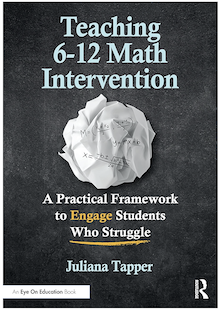 Juliana Tapper is a seasoned educator with experience as a math intervention and Algebra 1 teacher in South Central Los Angeles, East San Jose, and Denver. She is the bestselling author of Teaching 6-12 Math Intervention: A Practical Framework to Engage Students Who Struggle and a frequent presenter at national conferences like NCTM, NCSM, ASCD, and Learning Forward.
Having worked closely with students who have been historically unsuccessful in math, Juliana understands the intricacies of supporting learners who struggle. After her time in the classroom, she became a district math coach and TOSA (Teacher on Special Assignment) before founding CollaboratEd Consulting. Through her consultancy, she has provided professional development to schools, districts, state departments of education, and juvenile justice systems. Learn more about her strategies by signing up for her free online Math Intervention Masterclass.
Editor’s note: Math Wars Method® is a registered trademark.
Image: Unsplash+













I 100% use the Math Wars method in my classroom, and it has been transformative. I’ve had other math teachers observe my classroom and be in awe of how engaged my students are in the process. I could never go back to regular lecture/notes again.