
Grammar & Reading Are One Subject, Not Two
What if your grammar instruction is also reading instruction? It can be, writes Patty McGee. Here’s the research, and here’s where to start.
By Patty McGee
 Here is something the research has been quietly trying to tell us for years, and I think it deserves to be said out loud, with some enthusiasm:
Understanding how sentences work is a reading skill.
Not just a writing skill. A reading skill. When students understand how sentences are built, how clauses attach to each other, how a writer controls pace and meaning through structure, they don’t just write better. They read better. They access meaning that would otherwise stay locked inside a complicated sentence.
I know. Take a moment. Breathe it in.
If understanding how sentences work is a reading skill, then grammar instruction is also reading instruction. The two are not separate. They never were. We just taught them that way.
The problem is that a lot of grammar instruction looks exactly like it did in 1985.
The worksheets are the same. The red pen is the same. Students still identify parts of speech in sentences nobody would ever say out loud, still get their writing handed back with corrections they don’t understand and couldn’t apply even if they wanted to. It’s grammar as punishment. Grammar as compliance. Grammar as something that happens to students rather than something they actually get to do.
And here’s what that approach has produced over time: a lot of students who cannot hold a sophisticated sentence together as readers, and a lot of teachers who are exhausted from trying to make worksheets work.
We can do better. We can do something more engaging, more effective, and frankly more fun. The research is fully on board.
What the Research Actually Says
A national study of more than 6,000 students found that understanding how sentences are structured predicted reading achievement even after researchers controlled for family income, homework habits, and writing ability. Even after they accounted for everything else, sentence-level understanding still mattered. For reading.
A meta-analysis of research from 1998 to 2022 confirmed it. The ability to understand how sentences are put together is one of the strongest predictors of reading comprehension we have. Right alongside vocabulary. (See references)
So when students don’t understand how sentences work, they can’t fully access what those sentences mean. It’s not a decoding problem. It’s not a vocabulary problem. It’s a sentence problem. And a worksheet is not solving it.
The fix isn’t more correction. The fix is more doing. Students need to get their hands on sentences.
Manipulatives Build Readers (Not Just Writers)
The solution looks like students at a table, in partnerships and trios, holding pieces of sentences and deliberating where things go.
It looks like manipulatives.
Not worksheets. Actual physical sentence pieces that students pick up, move around, combine, break apart, and rebuild together. Grammar you can touch. Grammar you can debate with a partner. Grammar that makes students lean in instead of check out.
Here’s the thing: the conversation IS the instruction. When a student picks up a subordinate clause and says to their partner, “What if we put this part first?”, they are treating a sentence as a thing that can be rearranged, a thing with parts that connect in particular ways for particular reasons. They are developing a feel for how sentences work from the inside out.
And that feel? That’s exactly what a reader needs.
Research specifically shows that understanding sophisticated sentence structures, not grammar in general, predicts reading ability. A student who has physically moved a clause from the end of a sentence to the beginning, who has argued with a partner about whether it still works, who has felt how the meaning shifts ever so slightly – that student is not stopping cold when they meet that same construction in a text. They recognize it. They’ve built it before.
In the middle grades, texts get complicated fast. By fifth and sixth grade, students who haven’t developed a feel for how sophisticated sentences work hit those sentences like a wall. They read the words. They don’t get the meaning. They decide they’re “not a reader.”
They are a reader. They just haven’t been taught how sentences work. That’s a fixable problem. Manipulatives fix it.
The Equity Piece (Because It Always Comes Back to Equity)
Some students arrive at school having heard complex sentences their whole lives, absorbing subordination and layered clauses through years of rich oral language. When they hit a dense paragraph in a textbook, their brains have something to draw from.
Students who haven’t had that same exposure need instruction to build that same feel for structure. Not because they’re behind. Because they haven’t had the same opportunities. That’s not a deficit. That’s a circumstance.
Grammar manipulatives put everyone at the same table. Literally. Every student, in a partnership or trio, with their hands on the same sentence pieces, building and debating together. No assumptions about prior knowledge. No red pen waiting at the end.
That’s not remediation. That’s great teaching.
What to Try This Week: Sentences from a Sentence
Find the most luxurious sentence you can. Something rich and elaborate, full of interesting words, varied punctuation, a clause or two worth investigating. The more interesting the better.
Type it in a large font. Print it. Cut out every single word and every single punctuation mark so each piece is separate and holdable. Put a set in front of each partnership.
The instructions: use these pieces to create as many sentences as you can. Write each one down. And here’s the part students love: the pieces don’t get used up. Just because a word showed up in one sentence doesn’t mean it can’t show up in the next one. Every word is available for every sentence. Again and again.
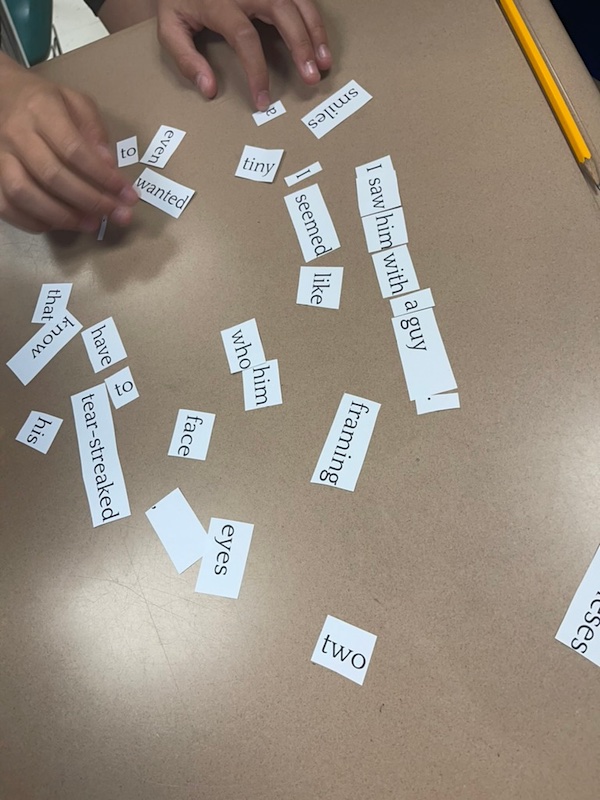
Partners work together, moving pieces, trying combinations, and reading what they’ve made out loud to hear if it sounds right. The conversation in the room will be about sentences. About meaning. About how words and punctuation do different kinds of work. That conversation is the instruction.
When partnerships have a collection of sentences they’re proud of, they find another partnership to visit. Not to guess the original sentence. Not to compete. Just to admire what the other pair made. “Oh, we didn’t think to put that word there. Read yours again.”
That’s it. That’s the whole thing. Every student spent time making sentences with their hands, their voice, and a partner. They experimented with how words and punctuation work together. They read their own creations and those of others.
They were building grammar skills. They were also building reading skills. We get to do both at once.
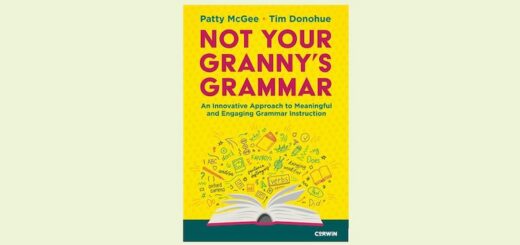
 Patty McGee is a veteran teacher and literacy educator. Her latest book, Not Your Granny’s Grammar: An Innovative Approach to Meaningful and Engaging Grammar Instruction (Corwin, June 2025), written with Tim Donohue, focuses on reinvigorating grammar instruction and includes access to bonus video and web content throughout the book.
Patty is also the author of Feedback that Moves Writers Forward (Corwin, 2017) and Writer’s Workshop Made Simple: 7 Essentials for Every Classroom & Every Writer (Benchmark, 2021). She regularly consults with teachers and principals in Grades K-12 on literacy teaching. Her favorite moments are in the classroom with both educators and students.
A former classroom teacher, media specialist, and staff developer, Patty was a 2002 recipient of the prestigious Milken Award for Excellence in Education. Read her other MiddleWeb articles and follow her at Bluesky and LinkedIn. Visit her website at www.pattymcgee.org where you can download her free strategy bank for writing instruction.
Feature image: Adapted for teaching example from Impossible Creatures by Katherine Rundell.















Patty McGee’s framing here is one of the clearest articulations I’ve seen of something literacy researchers have been circling for decades: that syntactic knowledge isn’t separate from reading comprehension — it IS part of reading comprehension. Students who can’t parse a complex sentence don’t just struggle to write one; they miss embedded meaning when they encounter one.
This is especially significant for students whose home language varieties have different syntactic conventions, or who are English language learners. Sentence-level study becomes a tool for comprehension, not just conformity to standard forms.
The move from “fix student writing” to “develop student reading through grammar” is exactly the reframe struggling readers need. Really glad this is getting louder in the conversation.
Finally someone who is ready to listen to what I have been saying for years. WE have to bathe children with language, to read to them, to read to each other. If they can make sentences,not simple sentences, but compound complex sentences, then they can make sense of what they are reading.
I love this concept. One cannot teach grammar in isolation and expect grand results; however, I do feel there is a place for teaching “patterns” before creating and /or mimicking sentence structures. Some high school students come in lacking the understanding (or exposure) of sentence structures and have to be taught the foundations of a simple sentence (without the pedantic terminology that can turn off students). I am eager to learn more about your practice and program.