Media Literacy: Teaching about Visual Media
 In the first part of this article on teaching visual media literacy, I told the story of a fourth grade class in New York City that sharpened their visual literacy skills significantly through a project that had them create their own public service announcements. In this second installment, we’ll look a little deeper into the components of visual media that make up a special language and “literacy” — and suggest ways teachers can begin to meet Common Core standards for the English Language Arts that address visual literacy.
 By Frank W. Baker
We can and should teach students that films and other visual media can be “read” in a conscious and deliberate way (just like we read words) to extract meaning.
Filmmaker George Lucas has been a long time advocate for visual media education: “We must accept the fact that learning how to communicate with graphics, with music, with cinema, is just as important as communicating with words,” he says. “Understanding these rules is as important as learning how to make a sentence work.”
The important role of writing & storyboarding
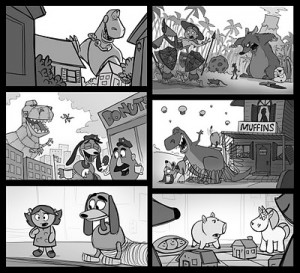 I like to remind educators that “all media started out as writing” and video/film is no exception. Before an inch (or megabyte) of film is shot, a script (called a screenplay) is produced. Having students write screenplays of scenes from a book they might be reading is one way to get them to appreciate film’s dependence on the written word.
Once their script/screenplay is final, students can begin the process of storyboarding the scenes. Many students are not familiar with the role of storyboarding. I want them to know that video games, TV commercials and movies are all storyboarded prior to production. (Today’s graphic novels are popular with Hollywood because potential studios can see the action and story already visualized, like a storyboard, in the graphic novel.)
Read a MiddleWeb book review about storyboarding.
Media Making & Meaning
All media makers, from political campaign consultants to toy commercial producers, understand that there is a language to film and video. Here’s one example of a way to help students get meaning out of some of that language.
 Imagine you’re photographing “Jack & The Beanstalk” and you wish to shoot the giant. You probably would never do that from high above his head. Placing your camera at the giant’s shoes, and pointing up, would produce an image in which the giant appears even taller than he is really is — truly larger than life.
Filmmakers would tell you that when you position the camera to aim up at someone from a low angle, you’re also making that person more important. In the inverse, shooting down on someone takes their power away from them. With that simple understanding shared, I would turn students loose with newspapers and magazines and ask them to find photos that demonstrate the “high angle” and “low angle” techniques.
Where you put the camera has meaning. But there’s also meaning in the use of lighting, set design, sound, costume, makeup and more. These comprise “the languages of film.”
Surfacing visual clues
I like to use the opening scenes from the Pixar/Disney film Wall-E when I teach visual literacy to students in the middle grades.
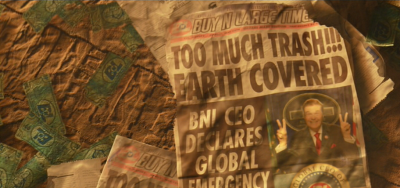 If you’re familiar with the film, you might remember that when we first meet the robot Wall-E, he is finishing his day’s work as a trash compactor. As he moves down a skyscraper made of garbage, he passes a video billboard (the only dialogue provided) which reveals that humans have departed Earth for a life of leisure aboard space ships, leaving the robots to clean up the trash. Other visual information can help us discover that the humans have been gone for thousands of years, and Wall-E is the last surviving artificial intelligence remaining on Earth. Due to the lack of dialogue in this scene, students must watch carefully for clues which help reveal the plot.
 I first show this opening scene to audiences with no instruction: they watch passively, as if they were sitting in a theatre, or watching at home from a comfortable chair. Before the second viewing, I will provide them with some guiding questions, printed on index cards, which require them to pay more attention. Some of the questions include:
• Does the action take place in the past, present or future: what are the clues?
• From what camera angle do we first see Wall E?
• Who is Wall-E’s sidekick? What role does he play?
• how does the music change as Wall E makes his way down the skyscraper of trash?
After the second viewing, participants share their observations, guided by the questions on the index cards. The second viewing responses make it a more enriching learning experience.
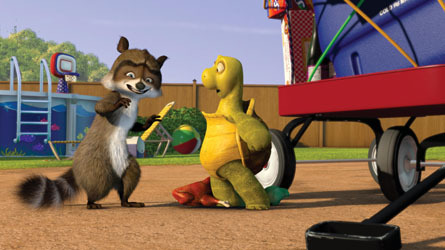 I also use clips from Toy Story and Over The Hedge to teach point-of-view (POV). Both of these animated films feature characters who are small: toys and animals. The animators for “Over The Hedge” have said they literally got down on the ground to see what life looks like from a raccoon’s point-of-view. Students begin to understand perspective and point-of-view when we help them to understand that where you position your camera is a big part of character POV.
In this way, I am using these popular culture texts as the hook to understanding film technique and to teaching Common Core standards. After they’re comfortable, then we can move on to more complex films.
Language of Film resources & the Common Core
Recently, I unveiled a Language of Film web site. On this site, you’ll find several categories (cinematography, lighting, costumes, audio–just to name a few). Each category includes links to recent news stories, teaching curriculum and resources, as well as recommended texts and videos.
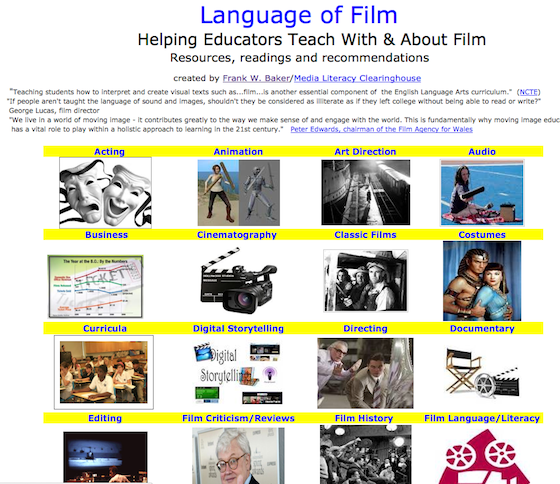
My goal is to make it easier for educators to integrate important 21st century skills into existing and developing curriculum. Did you know that the new Common Core Standards for the English Language Arts actually include specific references to film and the techniques students should know and understand?
Reading Standards for Literature: Integration of Knowledge and Ideas
CC.7.R.L.7 – Compare and contrast a story, drama, or poem to its audio, filmed, staged, or multimedia version, analyzing the effects of techniques unique to each medium (e.g., lighting, sound, color, or camera focus and angles in a film).
CC.8.R.L.7 – Analyze the extent to which a filmed or live production of a story or drama stays faithful to or departs from the text or script, evaluating the choice made by the director or actors.
With the buzz starting (already) about the Academy Awards (February 2013), movies, and those who make them, flim will be in the news frequently in the coming months. If you’re going to be teaching about film and/or film techniques, you’re sure to find plenty of material for student reading.
We all know that when we use video or film in the classroom, our students tend to sit up and pay attention. By going the extra mile, and teaching them screen education, we ensure that their viewing will not be passive, but rather active and critical.
 Frank W. Baker is the author of three books; his most recent “Media Literacy In the K-12 Classroom” (ISTE, 2012). Previously he wrote “Political Campaigns & Political Advertising: A Media Literacy Guide” (Greenwood, 2009) and “Coming Distractions Questioning Movies” (Capstone Press, 2007) He maintains the nationally recognized Media Literacy Clearinghouse website and conducts media literacy workshops at schools and districts across the US. He is a consultant to the National Council of Teachers of English (NCTE). He can be reached at fbaker1346@aol.com.