
Four Social Media Strategies for Principals
 By Ron Williamson and Barbara Blackburn
Adults often dismiss social media as a fascination of young people. But doing so minimizes one of the fastest growing trends in technology. That’s something principals can’t afford to do.
The Pew Research Center recently reported that 75% of teens have access to a smartphone and fewer than 12% have no cell phone at all (Lenhart, 2015). They also found that 92% of teens report being online every day while 75% of their parents use social media regularly (Duggan, Lenhart, Lampe & Ellison, 2015).
Social media tools have become a vital means for schools to quickly and efficiently disseminate information. Because of the almost universal access across all demographic groups, social media often reaches more people more quickly. It also reaches audiences that traditional forms of communication miss.
Strategies for Using Social Media
 While there are leadership challenges created by the prevalence of social media technology, it has also become a powerful tool. Principals can use social media to improve communication, provide information during school safety situations, increase collaboration, and enhance professional development.
Social Media as a Communication Tool
Most schools’ online presence has moved beyond the traditional website. It now includes a Facebook page (www.facebook.com), a Twitter account (www.twitter.com), blogs by teachers, principals or the superintendent, and YouTube (www.youtube.com) and Flickr (www.flickr.com) for sharing videos and photos about school events. Some schools have even developed an iPhone app (http://www.apple.com/webapps/) for their school.
 As more families use social media (75% of parents), schools have found that social media is the first place families turn to for information about their child’s school, particularly in times of severe weather or other emergency. Beyond this critical role, social media sites frequently share calendar information, student handbooks, school news, links to the school’s web site, and photos and videos of school activities.
Regardless of the tools you use to communicate online, there are five important tips for encouraging families to return, again and again, for information.
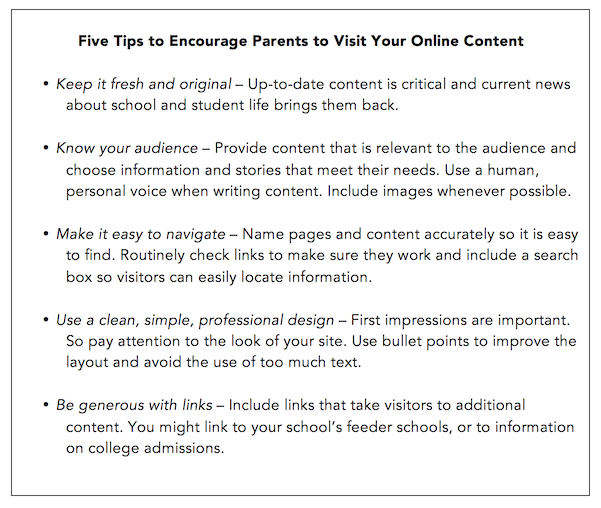
From: Williamson & Johnston, The School Leader’s Guide to Social Media
Social Media and School Safety
 Social media has become an essential tool during a crisis and should be an integral part of your school’s school safety plan.
When tornadoes devastated Joplin, Missouri and Tuscaloosa, Alabama in 2011, both school districts discovered that social media quickly became the primary means of communicating with families and staff. Often, it was the only way.
Their social media tools allowed them to locate students and families and to share information about school openings, bus routes and relocated classrooms. “After the tornado,” said one Joplin education official, “our Facebook page became our primary and only reliable means of communication. Our website and email were down for a week.” (See the USED report, Social Media in School Emergency Management.)
Social Media as a Collaboration and Productivity Tool
There is a whole set of social media tools that can be used to improve collaboration and productivity. Here are a few of our favorites.
- Scheduling Meetings – Our favorite tool, because it’s free, is Doodle. You can use it to identify potential meeting times based on work schedules and then invite participants. It provides an easy-to-read report once people respond to the invitation.
- Twitter Chats—Many schools and districts use twitter chats and hashtags to provide ongoing discussions about key topics or initiatives.
- Enhancing Collaboration –A wiki is a combination of a website and a place to post, revise, and edit work. They are especially useful for working with groups. What’s most powerful is that a wiki allows members of a group to collaborate on planning and implementing projects without having to constantly meet. Membership in the wiki can be controlled and the wiki keeps a record of any changes made by members. Our favorite is Wikispaces. There is a free plan for K-12 schools that is free of ads.
- Maintaining Meeting Records – We like Meeting Diary as a way to keep online records of meetings we’ve attended, along with the agenda and a summary of major decisions.
Social Media for Building Connections and Professional Learning
There are several social media tools that can support one’s own professional learning and connections. They include sites like LinkedIn to create a professional profile and build connections to others who share your professional interests. It’s important to separate your professional profile from your personal or family profile that might be on Facebook or other social media.
 We also encourage creating your own Personal Learning Network (PLN). It’s a way of using the Internet, and social media, to manage your own learning and to organize the information you receive. PLN’s are not new. Often they are just networks of professional contacts, but with social media it’s possible to add experts, and colleagues, from around the world to your network. Google has a set of tools for creating your own personal learning network, but many people create a Twitter account to build their network. Often, they don’t “tweet” frequently. They just follow a person, group, or organization like @MiddleWeb and gain access to the information and news that is shared. (See Kathy Schrock’s guide for educators to find lists of many education resources on Twitter.)
A Final Note
It is so easy to focus on the negative aspects of social media, but we encourage you to look beyond those challenges and consider the ways that social media has changed communication, improved collaboration, and our own personal and professional learning. Social media technology is a transformative tool, one that is reshaping how students, teachers, and school leaders learn and work.
Leave a comment on this post and share some ways you are using social media as a school leadership strategy.
 Ron Williamson is a professor of leadership and counseling at Eastern Michigan University. He was a middle grades teacher, principal and executive director of instruction in Ann Arbor, MI. He’s also served as executive director of the National Middle School Association (now AMLE) and as president of the National Forum to Accelerate Middle Grades Reform. Ron works with middle grades schools across the country and is the author of numerous books including The School Leader’s Guide to Social Media with J. Howard Johnston, and Principalship from A to Z with Barbara Blackburn.
 Barbara Blackburn is a best-selling author of 15 books including Rigor is Not a Four Letter Word. A nationally recognized expert in the areas of rigor and motivation, she collaborates with schools and districts for professional development. Barbara can be reached through her website or her blog. She’s on Twitter @BarbBlackburn. Her latest book, Motivating Struggling Learners: 10 Ways to Build Student Success, was published in July 2015.
_____
References
Common Sense Media (2010). Cyberbullying—Damage in a digital age. San Francisco: Author.
Duggan, M., Lenhart, A., Lampe, C., & Ellison, N. (2015). Parents and social media. Retrieved August 31, 2015 from www.pewinternet.org
Lenhart, A. (2015). Teens, Social Media & Technology Overview 2015. Retrieved August 31, 2015 from www.pewinternet.org
Porterfield, K. & Carnes, M. (2010). 10 reasons you should pay attention to social media. Retrieved December 16, 2010, from http://www.aasa.org
Williamson, R. & Johnston, J. H. (2012). The school leader’s guide to social media. New York: Routledge.










Great ideas! I agree with a lot of these. I found some interesting Facebook tips for not only principals, but superintendents as well!