Four Summer Strategies for School Leaders
 By Ron Williamson and Barbara Blackburn
Middle school leadership is a demanding job, one where you’re expected to stay up to date on innovative practices, legal and policy debates, and social or economic trends impacting schools. Too often, the demands of the job mean that little time is available to devote to your own professional learning.
Most leaders are connected generalists, interacting with many different people (students, teachers, staff, families) on a whole range of issues (curriculum, instruction, assessment, school activities, school safety, family involvement). That means a leader must understand new and emerging trends and be open to changing old habits and adjusting perspectives (Leslie, 2015).
Perhaps nothing is more important for leaders than to value our own learning. Summer provides one of the few times each year when principals have fewer demands on their time, their day is less structured, and they can devote more time to their own professional growth.
The question remains: how do we balance the day-to-day demands of school life with the need to continuously grow as a leader? Here are four strategies that can help you accomplish this goal.
 1. Be Intellectually Curious
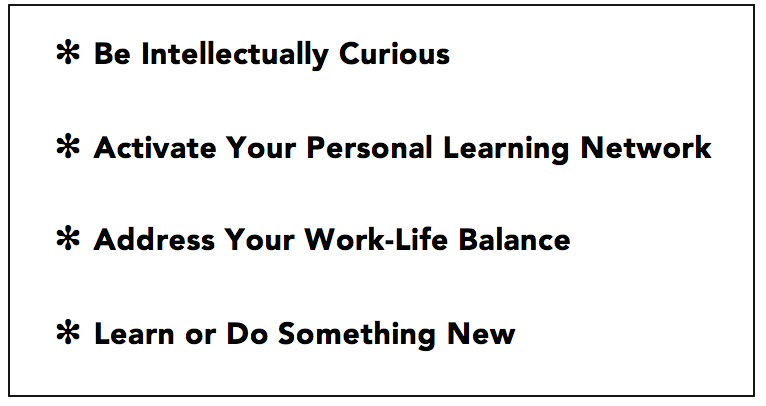
While it is impossible to predict the future, it is possible to anticipate trends and issues that may impact your school. Summer is a great time to read widely and learn about new instructional practices, about leadership in a whole variety of settings, or about social and economic trends that are likely to affect the “business of school.”
 A group of principals we surveyed suggest reading things about education but also expanding your reading list to include things you might not typically find time for during the school year. Try something from another field, or read about successful leaders in the private sector. Use both paper and electronic media to access books, news articles, blogs and other information. (Don’t overlook business-sector books about leadership.)
Almost every principal we work with values time talking with others about what she or he reads. That’s important because these conversations are an opportunity to challenge one another’s thinking and to provoke deep, rich discussion of issues.
2. Activate Your Personal Learning Network
Summer is also a time to activate or revitalize your personal networks with colleagues and friends. For decades leaders have had “networks” – contacts and friends who supported their work. We don’t suggest abandoning those traditional contacts, but we strongly encourage you to think about how a virtual network can expand your access to information, to others in situations similar to yours, and to noted experts in your field.
 A Personal Learning Network (PLN) is an online system to help you organize and manage your own learning. You can learn more about PLNs in our MiddleWeb article on leadership and social media, or in how-to articles like this or this or this.
Our principal advisors are also clear about the value of a LinkedIn account where you can build a network of professional contacts. It’s much like the old “rolodex” that sat on many desks, with 21st century connection tools built in.
LinkedIn allows you to present your professional resume, share your professional interests and expertise with others, and tap into some of the latest thinking in your field. LinkedIn is also a good way to learn about job opportunities that may be available in your field.
3. Address Your Work-Life Balance
Finding the balance between personal and professional responsibilities is a struggle for many people but especially school leaders. Principals find it a challenge because of the complexity of the job, the extended school day, and the expectations from teachers, from the senior leadership in their district, and from families and community.
 The idea that school leaders are available any time, any day of the week adds additional stress. Balance, in the truest sense of the word, is not about compartmentalizing your life. As David Allen notes in Getting Things Done (2015), it’s about being appropriately engaged with what you are doing in the moment.
Our principals found a number of strategies helpful to create an appropriate work-life balance. They suggest that you start by thinking about yourself, your patterns, and your aspirations.
Values and beliefs shape our actions and impact our personal set of life experiences. Here are some suggestions for assessing where you are and where you want to be.
Begin by defining what “greater balance” means for you and think about what you value. Being clear about your values is one key to establishing balance, or at least understanding why you don’t have balance. A conflict in values can create stress and disrupt the balance we seek.
 For example, you may value getting to work early but also value spending a little time with your spouse, children or significant other before your day begins. Perhaps you value finishing your work before you leave for the day, but also value attending your children’s after-school activities or being available to help with childcare or household chores.
► Set Realistic Goals and Expectations – Our perceptions, attitudes and assumptions often shape the expectations we have for ourselves. Try to keep it real. Check your assumptions about your work. Talk with your supervisor and with your family or significant other. Consider how to provide time for yourself and your own personal interests.
► Create Structures to Manage Your Work-Life Balance – Create a set of regular, consistent structures that help you maintain balance. There is not a perfect strategy – except the one that works for you. However, there are strategies that other principals found effective.
M any of our principals keep a journal to track their use of time and to assure that they have a running “to do” list. Use a single calendar, handle things only once, or break large projects into several small parts. Most importantly, identify a strategy that works for you and give yourself permission to modify the plan if it’s not successful. (Our colleague Frank Buck has some great advice right here at MiddleWeb.)
► Communicate, Communicate, Communicate – While planning is helpful to work-life balance, even more helpful is communication with your supervisor and with your spouse or significant other. In the absence of communication, others in your professional and personal life are left to form their own opinions and make their own judgments.
Here are some other useful communication tips. Hold a family meeting to talk about schedules and priorities. Add exercise, family activities and personal interests to your calendar. And always remember that work-life balance is not an event but a process that you develop over time.
4. Learn or Do Something New
Our emphasis in this article has been on learning and how summer provides an opportunity to read broadly, to revitalize your network of contacts, and to balance your personal and professional roles.
 Every expert we’ve talked with about staying current and recharging one’s enthusiasm for learning points to the value of actually learning something new.
Spend a few minutes and make a list of the things you’ve always wanted to do, or the things you wish you knew how to do. Prioritize the list.
Then do a brief online search about the topic, check your school district or recreation department brochure for classes or other resources. Search the web for summer webinars or self-paced how-to programs (YouTube will have it!). Talk with a friend who has skills in an area you want to explore, whether it’s fly fishing or website building. Then commit time to learning or doing something new.
Blanchard and Shaevitz (2015) found that seeing yourself as a continuous learner, not just in school, but in life, can serve as a catalyst for doing all of the things we mentioned earlier – being intellectually curious, connecting with other people, and finding work-life balance.
Final Thoughts about Summer
 Time between school years is a precious opportunity to reconnect with your passion for learning and with family and friends, and to recharge your spirit for the coming school year. These strategies can help you focus your energy before you come back for a new school year and keep you on track to becoming a highly successful leader.
References
Allen, D. (2015). Getting this done: The art of stress-free productivity. London, UK: Penguin Books.
Blanchard, K. & Shaevitz, M. (2015). Refire! Don’t Retire. Oakland, CA: Berrett-Koehler.
Leslie, I (2015). Curious: The desire to know and why your future depends on it. New York: Basic Books.
________
 Ron Williamson is a professor of leadership and counseling at Eastern Michigan University. He was a middle grades teacher, principal and executive director of instruction in Ann Arbor, MI. He’s also served as executive director of the National Middle School Association (now AMLE) and as president of the National Forum to Accelerate Middle Grades Reform. Ron works with middle grades schools across the country and is the author of numerous books including The School Leader’s Guide to Social Media with J. Howard Johnston, and Principalship from A to Z with Barbara Blackburn (2nd Edition available now).
Barbara Blackburn is a best-selling author of 15 books including Rigor is Not a Four Letter Word. A nationally recognized expert in the areas of rigor and motivation, she collaborates with schools and districts for professional development. Barbara can be reached through her website or her blog. She’s on Twitter @BarbBlackburn. Her latest book, Motivating Struggling Learners: 10 Ways to Build Student Success, was published in July 2015.