Teaching Media Literacy: It’s the Diet Ad Season

By Frank W. Baker
It’s not quite 2014 as I write, and already I’ve seen a half dozen commercials on television for weight loss. By the time you read this, you’ll probably be completely inundated by promises to remove the fat without sacrificing the calories or breaking a sweat.
After the holidays, the weight loss/diet industry bombards consumers (including susceptible tweens and teens) with messages on radio, television and the web. They know that many of us overindulged during the holidays, and they’re making promises (most too good to believe) that you can take that weight off fast. But can you? And can you believe everything they say? A little healthy skepticism goes a long way. Today we call it “media literacy.”
The Federal Trade Commission (FTC), which oversees advertising, has some very good advice for us:
“If you see an ad for a weight-loss product making fantastic claims, keep your money in your pocket.”
Fantastic promises are not hard to find. “The easiest diet ever” claims one product; “I lost 89 pounds” says another. Even though this sounds attractive and appealing, can it possibly be true?
“Testimonials from individuals are not a substitute for science, and that’s what Americans need to understand,” said an FTC chair quoted in the news back in 2007.
There are several specific claims the Trade Commission says dieters need to be aware of:
 1. You can lose weight without diet or exercise.
2. You can lose weight no matter how much you eat of your favorite foods.
3. You can lose weight permanently; never diet again.
4. You can just take a pill.
5. You can lose 30 pounds in 30 days.
6. Everybody will lose weight.
7. You can lose weight with our diet patch or cream.
To help consumers better cut through the hype, the FTC created a report entitled Red Flag: Bogus Weight Loss Claims. Using dramatic imaging and bold red pennants, it warned people about the deceptive advertising, offering some strong advice:
“Misleading weight loss advertising is everywhere, preying on consumers desperate for an easy solution. There is no magic bullet when it comes to losing weight. Claims for diet products that promise weight loss without sacrifice or effort are bogus, and in some cases, dangerous.”
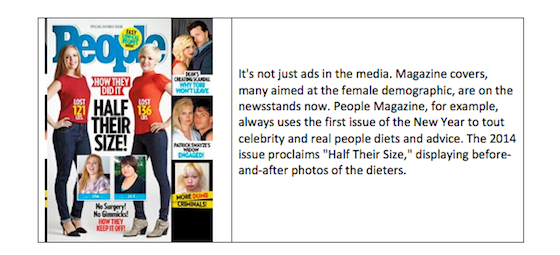
 As the FTC also notes, those before-and-after photos can be highly manipulative. Have you noticed how unhappy the people (usually actors) are and how poor their posture is in the Before photos — but how happy and attractive they look in the After?
And then there are the Photoshop-ed images of celebrities, endlessly tweaked by graphics designers to remove every blemish and sculpt perfect, fat-free bodies. (Does anyone think the Kardashians ever looked quite like this?)
Diet Ads in the Classroom: A Teachable Moment
So what does this annual avalanche of diet advertising mean to you, the classroom teacher? Here’s another “media literacy” teachable opportunity, while you also sharpen critical thinking skills.
 You won’t have any problem locating weight loss ads in many of the magazines you come across during January (and beyond). You can also do a simple Google image search for “diet advertising” and turn up a virtual history of diet ads. Consider using some of this material to teach students not only about persuasive techniques, but also argument writing –an important Common Core standard. As this blog post explains, the CCSS expects students to learn how to argue in writing using reasoning and evidence. Applying these standards of argument to diet advertising quickly reveals the difference between persuasion and argument.
 Visual literacy is also an important skill for your students to develop. They should be given time to read print ads, as well as analyze television commercials, in order to identify audience, purpose, wording, visual and audio techniques and more. This handy two-page document offers good advice for deconstructing print ads. In this lesson plan I wrote previously, there is timely advice as well, and a series of questions your students can use that will help them identify the key elements in commercials.
Consider the covers of magazines as content to be studied also. Here at MiddleWeb, I previously wrote about using colorful magazine covers to engage your students. Since the new Common Core standards position our students as “reading detectives,” they should be developing the basic skills to observe covers for layout, design, color and more, and then provide evidence to prove the intent of the editors.
More resources
I have created a website with a multitude of resources for teaching this topic. I invite you to peruse it and consider how it can help you engage your students in some of the most powerfully persuasive messages out there today.
Frank W. Baker is a media literacy education consultant and the author of three books, including Media Literacy In the K-12 Classroom (ISTE, 2012). He contributed two chapters to the just published Mastering Media Literacy (Solution Tree, December 2013). In November 2013, Frank was a recipient of the National Telemedia Council‘s annual Jessie McCanse Award given for individual contributions to the field of media literacy over at least 10 years. Follow him on Twitter @fbaker.