Anchor Activities Help Us Go with the Learning Flow
A MiddleWeb Blog
 There are moments when I feel guilty that I’m not actually teaching.
There are other times, however, when I feel an overwhelming sense of contentment in knowing I am doing my job well by getting out of the way – that the kids are learning, and that they are enjoying it.
One of these moments occurred at about 2:30 on the Friday before Spring Break. The room stayed relatively calm, but there was a hint of palpable excitement in the air all day.
Four kids were absent, having left early for family vacations. This gave us the opportunity to get some organizing, cleaning, and project work done, with some time left at 2:45 to go outside for some fresh air and fun (to kick-off the week-long hiatus from school work).
 At 2:30, however, 19 kids sat, clicking around in intense concentration as they lost themselves in their most recent Life Science research project. They were unaware of the time. They were unmindful that in 35 minutes they would begin a much needed break from all of their hard work. I smiled and chuckled a little as I walked over to the light switch to flip it on, signaling the end of today’s laptop session.
To teach
I find myself pausing more often these days, just to observe the kids in action. Sometimes I feel guilty about this, as if they are working, and I’m not doing anything.
Each day can be a struggle, trying to fight against an internal drive to “teach.” My progress is hindered by some strangely imbedded idea that teaching must always be an action verb.
I am reminded, during these moments of simple observation, that there is a need for verbs of being in the world of teaching.
There are discrepancies among experts in grammar about how to define verbs of being, but there is a need for what I consider to be “passive” verbs, verbs that aren’t as visible as list, explain, lecture, discuss, draw, or model.
What about the verb teach? Does it mean to transfer information to?…to guide in exploration?…to allow for independent exploration and discovery? (Some of my own musings.)
The laptop triple play
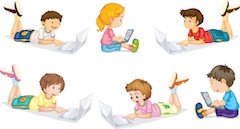 One of the easiest times to combine direct instruction with this more passive kind of teaching is when we have signed up for the laptop cart. It has become a steady part of our weekly schedule as we try to incorporate more technology into our learning.
The direct instruction component is made much easier because of the interactive whiteboard I have been using since last year. We are lucky. I can show them on my desktop while I explain tool bars and drop menus. They can see me model, hear my explanation of these features, and then use their own keys to practice the skill. It’s the triple play of multi-sensory learning.
As expected, there are glitches in technology. With a standard ratio of 23:1, things can get off course rather quickly, but we have a system in place to prevent disaster. Our policy is as follows:
“If you touch something, and you don’t know what you did, don’t touch anything else! Quickly raise both hands (as if you were caught in the middle of a bank heist) and wait patiently.”
This practice prevents added confusion, minimizes loss of class work, and is a great way for me to get a quick visual on who needs immediate help.
Anchors aplenty
 Using laptops on a regular basis offers me valuable time to observe the kids, to take a more passive role in their learning. Access to individual student laptops has also given me the opportunity to redefine what an “anchor activity” is. This phrase has been around as long as I can remember, but I never fully grasped its meaning. When I was a new teacher, it was a tool to keep the fast-finishers busy, while the rest of the class was still “working.” Through the years, our anchor activities have become a way for all of us to be highly engaged in meaningful activities as “active” learners.
True anchor activities give me the time to combine active and passive teaching. They allow for independent skill practice and individual discovery. Both are essential components in effective teaching.
Using technology to develop this balance has made the task easier. Here are some anchors we’ve been using this year:
Links to Anchors that Slow the Current Down a Bit:
▶ http://www.seasky.org/ (interactive exploration of the ocean and creatures of the deep)
▶ http://www.brainpop.com/games/foodfight/ (one- or two-player game that helps illustrate the cause/effect relationships within animal communities….The kids love the name of the game, too!)
▶ http://constitutioncenter.org/timeline/flash/cw.html (interactive timeline with access to primary sources, audio and video snippets, and highlights of US History)
▶ http://www.sheppardsoftware.com/states_experiment_drag-drop_Intermed_State15s_500.html (click and drag states into a blank US map…this site offers other geographical regions and locations as well!)
▶ http://www.sudoku.com/ and http://www.coolmath-games.com/0-rubikscube/ (developing logical thinking, spatial relationships, and attention to detail can be fun!)
Following the flow of student learning
 The teacher’s need to observe and go with the flow is still an area in which the water gets murky for me. But I am learning to let go of my feelings of guilt for not actively teaching every moment of the school day, for letting the kids anchor themselves in independent learning. There is great value and importance in passive teaching, for the kids and for myself.
Last week I learned that the okapi, a deer-like animal with zebra-striped legs and giraffe relations, can lick its eyeballs and clean out its ears with its incredibly long tongue (disgusting, but true). That may just be a random fact in a world full of trivia, but the look in Zoe’s eyes when she reported her discovery was in no way random.
random: adj. proceeding, made, or occurring without definite aim, reason.
Anchors also help us enjoy the beauty of a new harbor. They give us time to rest, regroup, and determine our next course. Navigation isn’t an exact science. It’s one of constant change and adaptation. We need anchors…and less guilt.