Why We Have Smart Tech & Shrinking Brains
On an average school day, do your students spend more time with their devices — or with you? Don’t fall for the edtech acceleration illusion, warns Dr. Murray, who describes the many pitfalls of “frictionless technology.”
By Sonya Murray-Darden
 It’s Wednesday afternoon, and Mr. Reyes is reading the third essay in a row that sounds nothing like the student’s writing. The vocabulary is polished. The transitions are flawless. The voice is gone.
He glances around the room. Half of his eighth graders are on Chromebooks. One is on a math app, solving problems while she copies the answers. Another is skimming an AI summary of plate tectonics he didn’t assign. A third is on the “right” tab – but his eyes haven’t moved in two minutes.
“It used to work,” Mr. Reyes thinks. “Now I can’t tell what my students actually know.”
Every essay on his desk looks accelerated. The dashboard says proficiency. But the polish belongs to the tool, not the child. The proof shows up on Monday, when the students who seemingly “got it” on Friday can’t explain it, build on it, or transfer it.
That’s the illusion. The output looks accelerated. The pace feels accelerated. The data looks accelerated. Underneath, though, students are missing out on the very reps that build durable learning. Frictionless technology isn’t acceleration. It’s remediation in disguise — and the remediation has little or no lasting effect.
❑ Pause and reflect: Where in your classroom does the dashboard say one thing — and your gut say another?
Relationships First
For years, I’ve argued — alongside my co-author Gwendolyn Turner — that the most important shift in education is the move from remediation to acceleration. In Serving Educational Equity: A Five-Course Framework for Accelerated Learning (Corwin, 2023), we lay out five “courses” educators must serve to every learner, and we are deliberate about the order. Relationships come first. Not because they’re nice, but because the brain literally cannot do the work of acceleration without them.
In our framework, the relationship is the dining table itself. Curriculum, data, and student agency are the courses we serve on top of it. Without the table, every course hits the floor. The table — the relationship between a trained educator and the child in front of her — is what makes the entire meal possible.
The framework holds a promise. We do not waiver on grade-level instruction, where students are seen, empowered, in relationship, valued by data, and engaged every single day. That’s SERVE.
The Serve Framework
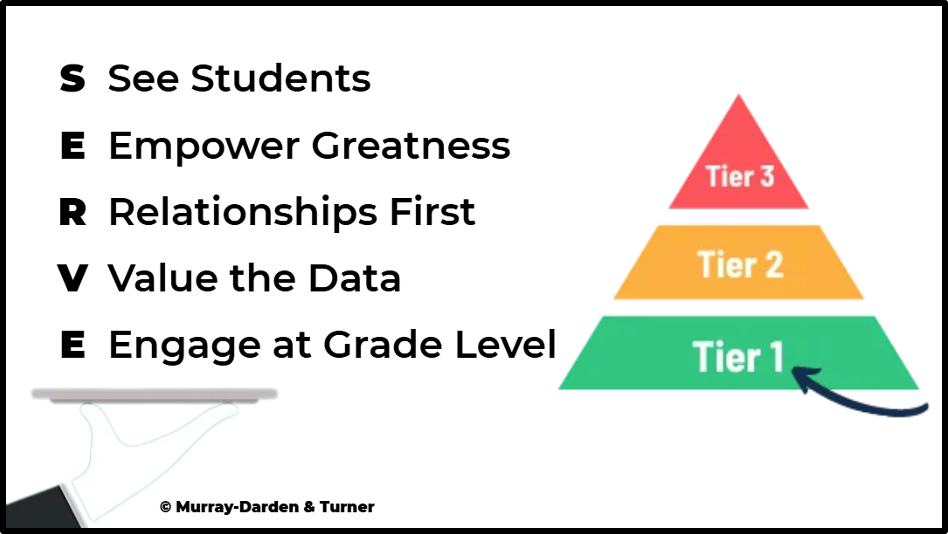 (from Serving Educational Equity, Murray-Darden & Turner, 2023)
That last E — Engage at Grade Level — is the one imperative that frictionless technology most often violates. SERVE is the promise. Substitution is the betrayal.
I know this because I lived it.
My second-grade teacher, Ms. Cross, put my writing on the wall of our classroom. I was seven. She didn’t have an app. She had a piece of tape and a belief that what I’d written deserved to be seen. That single act — one human, seeing one child — shaped a neural pathway in me that no software has ever come close to building. I became an author in that moment because Ms. Cross said, out loud, in front of everyone, that I was one.
Ms. Cross was the table. Without her, none of the curriculum, none of the data, none of the agency I would later develop as a learner would have had a place to rest. The piece of tape didn’t just hold my writing on the wall. It held me up.
That is acceleration. Not a faster app. A teacher who increased what a child believed she was capable of — and gave her real cognitive work to do to prove it true.
❑ Pause and reflect: Who was your Ms. Cross? What did they do that no app could ever replicate?
Tech Is Replacing the Teacher
A platform can deliver content. It cannot read a face. It cannot hear hesitation in a student’s voice and know to slow down. It cannot decide that this child needs a harder question and that one needs a hand on the shoulder. That is the expertise of a trained teacher — the most sophisticated diagnostic instrument in the building. No app comes close.
But teachers are under enormous pressure to cover — pacing guides, scope and sequence, the curriculum we “have to get through.” We say “students aren’t ready for grade-level work” — and then we hand them a tool that quietly proves us right.
And here is the truth no platform will tell you: when coverage wins, depth gets sacrificed. Frictionless technology promises to help teachers cover more, faster. What it actually does is help them cover more, in shallower depth. The thinking that doesn’t happen in the room today shows up as the gap that opens up next year.
The fix begins at the planning table. Plan for what students will understand, not just what they will do. Activities, apps, and tasks are not lessons. They are containers for thinking. If we don’t name the thinking the lesson is meant to build, the tool will do the thinking instead — and the children will leave the room having done a lot and understood very little.
The data confirms it. Students are off-task on their devices for roughly two-thirds of class time. Fewer than 30% of Gen Z students report feeling engaged in their classrooms (Gallup, 2024).
On January 15, 2026, cognitive neuroscientist Dr. Jared Cooney Horvath testified before the U.S. Senate that the way we’ve designed classroom technology — frictionless, effortless, always finishing the cognitive work for the student — is silently dismantling the very mechanisms the brain uses to learn.
He explained it with the clearest analogy I have heard in twenty years of education:
If you went to the gym and someone gave you a tool that would lift the weights for you, you would never expect anyone to get strong. The strength comes from the effort, from the work.”
The effort is the education. We’ve handed our students tools that lift the weights for them — and then wondered why they aren’t getting stronger.
It’s not that our students are lost. It’s that the tech got them lost.”

Why the Brain Isn’t Fooled
The illusion works on adults. It doesn’t work on the brain.
Robert Bjork’s research on desirable difficulties shows that the struggle to retrieve information from memory strengthens it. Daniel Willingham puts it more bluntly: memory is the residue of thought. If a student offloads thinking to a chatbot, there is no residue. John Sweller adds that the brain learns at the edge of working memory — and tools that pre-digest content keep cognitive load artificially low. It feels kind, but neurologically it’s a missed workout.
And as Linda Darling-Hammond’s Science of Learning and Development confirms, lasting learning happens inside relationships. A child who feels seen, safe, and believed in encodes more deeply than a child who doesn’t.
Real acceleration requires effortful retrieval, productive struggle, deep engagement, and human connection. Every one of those is something the brain has to build from the inside out — with us, in the room.
Frictionless technology removes every one of them. It eliminates the retrieval. It removes the struggle. It replaces the generation. It stands in for the relationship. It is not just unhelpful for acceleration. It is anti-acceleration.
The Test That Cuts Through Everything
There’s one question that cuts through every classroom-tech decision:
Does the student have to think before, during, and after using it — or does the tool think for them?
If the tool requires retrieval, generation, or evaluation, it’s accelerating. If it delivers polished output that the student didn’t have to build, it’s substituting — no matter how impressive the dashboard looks.
❑ Pause and reflect: Name one tool you’ll use this week. Run it through the test. Is it accelerating — or substituting?
Five Monday Moves
You don’t need a new initiative. You need five small shifts.
- Plan techless first. Before you ask “what app or platform will I use?” — design the lesson without one. Decide where the thinking lives, where the relationship deepens, where the struggle happens. Then ask whether technology actually accelerates that thinking or quietly does it for the student.
- Pick one lesson where a tool has been doing the cognitive heavy lifting. Name what brain work it was quietly doing for the student.
- Build in retrieval, not review. Replace “look back at your notes” with “close everything and write what you remember.”
- Make thinking visible — out loud, to another human. One oral check, partner explanation, or whole-class discussion per day.
- Tell students the why. Memory is the residue of thought. They are more interested in this than we expect.
Back to Mr. Reyes
On Friday, Mr. Reyes tries something small. Before opening Chromebooks, he asks his eighth graders to spend seven minutes writing — by hand — everything they remember about how the continents move and what drives them. No notes. No screens. Then each table talks it out for five more.
The room is quiet in a way it hasn’t been in months, then noisy in a way it hasn’t been in months. A few students sigh. One asks if he can “just look it up.” Mr. Reyes smiles and says no — this part is your brain’s job, and your table’s job.
What they produce is messier than what the AI would have written. It is also, unmistakably, theirs. And when he reads their paragraphs that night, for the first time in a long time, he can tell what his students actually know.
That’s not the illusion. That’s the real thing.
The Bottom Line
Looks like acceleration. Lives like remediation.
Technology in our classrooms isn’t the enemy. Substitution is. We can’t control how seductive the tools become. We can control whether the thinking still happens in the room.
Ms. Cross didn’t have an app. She had a piece of tape and a belief. Mr. Reyes is rediscovering the same thing on a Friday afternoon, with seven minutes and a blank sheet of paper. Every teacher reading this can do this too.
Acceleration over remediation. Technology can’t replace the power of human connection.
That’s where learning — real, brain-built, lasting — begins again.
References
Horvath, J. C. (2025). The digital delusion: How classroom technology harms our kids’ learning and how to help them thrive again. Routledge.
Murray-Darden, S., & Turner, G. (2023). Serving educational equity: A five-course framework for accelerated learning. Corwin.
 Dr. Sonya Murray is the founder of Accelerated Education Consulting, a Missouri Leadership Specialist with EducationPlus, and a Professor at Saint Louis University. She is the co-author of Serving Educational Equity: A Five-Course Framework for Accelerated Learning (Corwin, 2023).
Sonya has been an executive coach to leaders in many schools, doing gap-closing work, including transformations from 1 star to 5 stars on state report cards. She partners with schools nationally to build classrooms where every child accelerates through productive struggle, deep engagement, and the human relationships that make learning stick. Learn more at Accelerated Education Consulting.