Equitable Instruction for K-8 English Learners
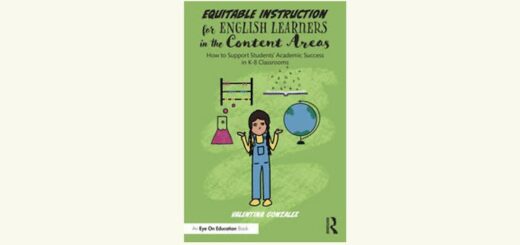
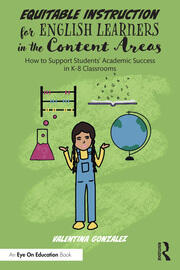
Equitable Instruction for English Learners in the Content Areas: How to Support Students’ Academic Success in K-8 Classrooms
By Valentina Gonzalez
(Routledge/Eye On Education, 2025 – Learn more)
Reviewed by Melinda Stewart
 As a secondary educator who has spent more than three decades teaching in rural classrooms, sometimes with limited institutional support for multilingual learners, I found Equitable Instruction for English Learners in the Content Areas by Valentina Gonzalez felt both familiar and disruptive.
Familiar because it affirmed practices I have learned through experience; disruptive because it firmly challenged lingering misconceptions that still surface in schools shaped by high-stakes testing, rigid pacing guides, and monolingual norms.
At the heart of Gonzalez’s work (her public school credentials are impressive) is a clear stance: equity is not accidental. Equity must be designed into daily instruction. Too often, teachers feel unsure how to support English learners without slowing down, simplifying content, or lowering expectations. Gonzalez directly addresses this tension, naming a common but harmful misconception. There is a misconception that simplifying language equals equitable instruction. In reality, simplification often strips away grade-level vocabulary, conceptual depth, and academic opportunity. Equity, Gonzalez argues, is not about reducing complexity but about amplifying language while maintaining content rigor.
 Although it is not a new idea, Gonzalez makes the assertion that all students are language learners, and therefore every teacher is a language teacher. Her description of how this looks in a classroom is one of the most powerful reframes in the book. Language is not an accessory to learning; it is the medium through which meaning is constructed, shared, and assessed. Gonzalez reminds us that communication is a collaborative act that allows students to take thoughts, shape them, and pass them to others. When students feel frustrated, confused, or irrelevant, it is often because instruction has failed to make meaning comprehensible or participation safe.
Embracing multilingualism in the U.S.
Globally, multilingualism is standard. In Equitable Instruction for English Learners in the Content Areas, Gonzalez challenges the deeply embedded U.S. assumption that monolingualism is the norm and highlights some of the inequities that are created when schools treat English learners as a homogeneous group.
Linguistic identity, she writes, is rooted in culture, experience, and self-worth. True linguistic equity means embracing students’ full language repertoires, not erasing them in the name of assimilation.
In the book Gonzalez urges educators to move beyond a “can-do” mindset toward recognizing students’ full potential, ensuring assessments reflect authentic understanding rather than linguistic limitation. She also reminds educators to stay current on policies regarding multilingual learners. This is critical.
In the book Gonzalez references the policies and policy shifts that protect multilingual learners, but since its publication in early 2025, more current policy aims for “assimilation” and has rescinded the alignment in thinking that Gonzalez references. Advocating for multilingual learners requires sustained effort in a shifting political environment.
The book’s actionable structure
What makes this text especially useful for practicing educators is its actionable structure. Strategies are presented with clarity. Gonzalez explains what the strategy is, how it supports language and content, who it benefits, and how to implement it. Most important for me, who has often been a department of one, she gives tips, variations, considerations, and provides classroom and student examples.
Gonzalez shares tools such as sentence stems and frames, clear content and language objectives (the what and the how), sketchnotes, and varied response types to support oral language development and authentic use of academic language within the school day.
Her emphasis on writing and speaking every day within a safe, messy, collaborative environment reinforces the idea that learning is iterative. Her mantra of “read a little, try a lot, share, and make it messy” mirrors how real instructional growth happens, especially when teachers read and reflect together.
Beyond K-8
While the book is written with K–8 educators in mind, its principles resonate strongly at the secondary level, where language demands intensify and students are more likely to disengage if instruction feels inaccessible. I did find myself wishing for more discipline-specific secondary examples, yet the adaptability of the strategies makes them transferable across grade levels and content areas.
Understanding students, including their languages, histories, and ways of communicating, is foundational to making content comprehensible and meaningful. Equity, Gonzalez makes clear, lives at the intersection of curriculum, instruction, assessment, and how students see themselves valued within the classroom.
Melinda Stewart has been an educator for 30 years. She has an MA in Teaching, Education and Learning and has done graduate work in the areas of English as a Second Language, Reading, Spanish, and most recently English Language Arts. She is currently working as a Spanish teacher and ELM coach in rural southern MN. Melinda is an MEA and AFT professional development facilitator and trainer who has a deep passion for learning and equity.