
Powerful Iconic Images Can Educate & Inform
Media literacy education consultant Frank Baker returns with another in a continuing series on visual literacy, offering educators ideas for engaging students in critical thinking about images and issues from the news and popular culture.
 By Frank W. Baker
Powerful images have a way of making us remember important people and events. And photographs, seen by millions of people, also have a way of raising consciousness about issues, many of them tied to health and gender awareness. When a cultural icon becomes associated with deadly illness or controversial lifestyle, perception shifts. Students need to be aware of this important aspect of media literacy.
Consider, for example:
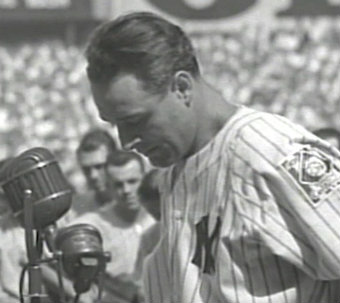 July 4th 1939: For many baseball fans this date is etched in their memories. On that day New York Yankee Lou Gehrig retired, making the announcement before 69,000+ fans, saying he considered himself to be “the luckiest man on the face of the Earth.” According to reports there was not a dry eye among the thousands of fans who watched at Yankee Stadium. The reason for his retirement: doctors had diagnosed him with a rare form of amyotrophic lateral sclerosis (ALS) disease, a condition which would from then on be known as “Lou Gehrig’s Disease.” His retirement also meant the end of a record 2130 consecutive games playing streak. He put a face on the disease.

Doris Day and Rock Hudson, July 18, 1985. Chris Hunter / AP Photo
Forty-six years later, on July 25, 1985: Actor Rock Hudson, a matinee idol to millions of women, issued a press release to say he had AIDS (Acquired Immune Deficiency Syndrome). The handsome, virile film star had appeared gaunt in public and there was much speculation about his declining health. “His illness and death have moved the fight against AIDS ahead more in three months than anything in the past three years,” said Bruce Decker, chairman of California’s AIDS Advisory Board Committee. (Source) Rock Hudson put a face on the disease.
 Six years later, on November 7, 1991: Basketball mega-star Earvin ‘Magic’ Johnson retired from the NBA because he was HIV-positive. CNN, the only all-news cable network at the time, carried the announcement LIVE. He has helped educate millions about the disease. Like Rock Hudson, Magic also helped put a face on the virus related to AIDS.
 November 1998: Actor Michael J Fox revealed that seven years earlier he had been diagnosed with Parkinson’s Disease, “a progressive degeneration that ultimately renders some patients unable to walk, talk or take care of themselves.” (Source) He had just undergone a surgical procedure to lessen the disease’s effects. Despite his prognosis, Fox has continued to perform on television and lead the fight to find a cure. Fox helped put a face on the disease and inspire others with Parkinson’s.
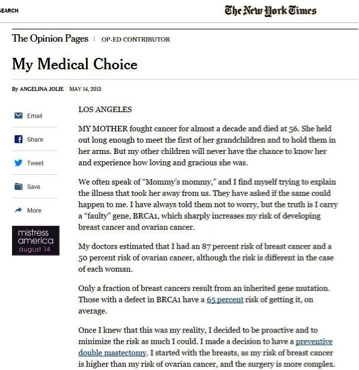 May 13, 2003: Actress Angelina Jolie published an op-ed in the New York Times newspaper explaining why she decided to undergo preventive double mastectomy. Due to an extensive family history of breast and ovarian cancer and having the BRCA1 gene mutation that dramatically raised her risk of cancer, she made the decision she called “my medical choice.” Her surgery and decision helped raise awareness about genetic markers and preventative action.
 April/May 2015: Vanity Fair magazine and ABC-TV help former Olympic gold medalist Bruce Jenner reveal to the world that he is now a woman who prefers to be called Caitlyn. An interview the 65-year old Jenner gave to ABC’s Diane Sawyer was watched by almost 17 million people. (Source) Pop culture photographer Annie Leibowitz got the Vanity Fair cover assignment revealing the new look. Gossip tabloids and websites had been publishing mostly unflattering photos of Jenner for more than year, speculating on his conversion. As transgender people seek recognition and acceptance, Jenner’s visual “reveal” helped put a face on this issue.
Teaching about high-impact images
All these images and announcements helped tell important stories within the global arena of popular culture. Whether the storyteller is a celebrity or a new social media phenomenon, once they gain the stage, they can help explain their issue, disease or condition to a world audience. They become tomorrow’s water cooler discussion topics, prompting debate and reflection, and even social action.
In terms of media literacy, the media have once again become important agents not only by communicating (and sometimes sensationalizing) the news, but also by explaining it and educating news consumers. Would the focus on health and gender issues have been as intense and long-lasting without the celebrity spokespersons? Perhaps that’s a good starting question for teachers and their students to consider and discuss. (Also see my MiddleWeb article “Help Students Close Read Iconic Images.”)
What other issues and examples of visual impact might teachers and students identify? How do teachers navigate discussions about these topics, which many students will be aware of because they are a part of popular culture? I hope you’ll share your own thoughts in the comments here.
Frank W. Baker is a media literacy education consultant and the author of three books, including Media Literacy in the K-12 Classroom (ISTE, 2012). He contributed two chapters to Mastering Media Literacy (Solution Tree, 2014). He is a recipient of the National Telemedia Council‘s annual Jessie McCanse Award given for individual contributions to the field of media literacy over at least 10 years. Follow him on Twitter @fbaker and visit his resource-rich website Media Literacy Clearinghouse.