
Why Argument Writing Is Important to Teach
By Leslie Skantz-Hodgson and Jamilla Jones
Is argumentative writing important for today’s students to master?
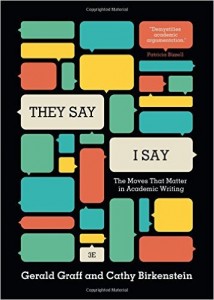
This summer we were among six educators who thought diving into the argument aspect of teaching academic writing was important enough to gather during the break and share thoughts on a close reading of They Say/I Say: The Moves that Matter in Academic Writing (third edition) by Gerald Graff and Cathy Birkenstein.
In addition to learning together, we also argued and debated together (a lot) about the strategies and beliefs reinforced in the text.
Looking inward and outward
 We were a mixed group of teachers of disciplines — science, English language arts, humanities, special education — across the grade levels. Our inquiry work was supported by a grant from the National Writing Project.
Our common goal was to learn how to impress upon our students the value and importance of developing their arguments “not just by looking inward but…by listening carefully to what others are saying and engaging with other views.” (Birkenstein/Graff, p. xxvi)
This approach to critical thinking and academic writing is a practice emphasized in the Common Core State Standards for math and English Language Arts, as well as in the Next Generation Science Standards.
More important to us, argument strategies allow students to “stretch what they believe by putting it up against beliefs that differ, sometimes radically, from their own. In an increasingly diverse global society, this ability to engage with the ideas of others is especially crucial to democratic citizenship.” (Birkenstein/Graff, p. xxvi)
Placing ideas within a larger context helps students see how their ideas fit and where their ideas fit in the broad conversation.
A return to socialization and conversation
In the preface of the book, Birkenstein and Graff state that one of the central goals is to demystify academic writing by returning it to its fundamental roots in socialization and conversation. The book’s title — They Say/I Say — is a pointed reminder of argument strategies, and we interpret it as the idea of: “I’m going to pay attention to what they say, so I can formulate my thoughts or arguments and say what I need to say.”
 Another reason we found this text refreshing is that while it attends to the requirements of the Common Core, it also attends to the needs of the writer. For example, the authors make the argument for using “first person” point of view in argumentative writing:
Although you may have been told the “I” encourages subjective, self indulgent opinions rather than well grounded arguments, we believe that texts using ”I” can be just as well supported–or just as self- indulgent–as those that don’t. (Graff/Birkenstein, p. 72)
As educators, we often tell our students not to use first person pronouns in their argumentative writing, as a way to keep a distance from the topic. But in order to argue, we have to take in and evaluate, and then perhaps refute, what the other side says. Of course, our personal beliefs and feelings then become a part of the argument. Jamilla, in particular, feels like this part of the book will help refine her teaching practice.
Practicing argument within our discussions
In the course of our book study, we employed various argumentative writing strategies and activities that we believe can be used in the classroom.
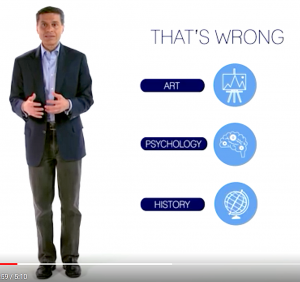 Facilitator Jack Czajkowski set a multimedia tone to the discussions by creating and sharing a text set for us that connected our reading to a YouTube video – “Fareed Zakaria on American Innovation Beyond STEM” – with posts at the book’s companion blog, They Say/I Blog, which enabled us to synthesize information and broaden our study of argument writing.
In our first gathering as an inquiry group, we used a protocol called The Final Word (NSRF) that had us sharing passages that resonated with us and telling why. This familiar tool generated the kind of discussion called for in the Common Core’s ELA speaking and listening standards.
The second meeting had us practicing the writing of a summary following the guidance in Chapter 2 of the book and applying the lessons of Chapter 3, “The Art of Quoting,” to an essay.

The third meeting found us sharing summaries of our assigned chapters in a jigsaw approach, identifying the rhetorical moves in our choice of essays from among those supplied at the end of the book. As a final “putting it all together” activity, we all shared a “Dear Confused” letter written to a student or colleague explaining the major takeaways from the whole book.
The book includes useful templates, which we regarded more as sentence starters than the traditional graphic organizer for a complete essay, but which were still very useful. These templates offer a scaffolded approach to argument for writers. For example, one is structured as: “A number of _________have recently suggested that ________.“ Another template reads “It has become common today to dismiss______.”
Grounding writing in fundamentals
The authors also address (and thereby model how to acknowledge and rebut a counterclaim) the worry that using templates could hinder individual voice and creativity. They argue, appropriately enough, with an analogy: just as a jazz musician must master the established form and rules of music before they depart on variations, so must a writer know the forms and rules of argument writing.
 They also provide lists of verbs for expressing disagreement, agreement, making a claim, and more. While many of these academic words may be advanced for middle schoolers (the book is used mainly at colleges and high schools), the list could be adapted for middle school.
One of the hardest things to teach students when integrating argumentative writing in the academics is to pay attention to the counterclaim, and as participants in the book group, we paid particular attention to the reasons why counterclaims are so important to students making claims in their argumentative papers.
How we plan to share the book
As a curriculum coordinator responsible for ensuring that our academic courses are aligned with the most recent standards adopted by the Commonwealth of Massachusetts, Leslie found this book to be an invaluable resource for teachers at her school, and she plans to replicate this book study in her school district.
As an instructional coach and ELA teacher, Jamilla found the strategies used in They Say/ I Say useful because the concepts are grounded in discussion first and then move into academic writing. Writing is speaking on paper and the authors of this text are cognizant of this. In order for students to become comfortable sharing their beliefs on paper, they must become comfortable sharing ideas within a group orally.
Skills that move beyond the classroom
 As a society we are constantly trying to navigate the often murky waters of media and social media, and our students are bombarded with the opinions of many voices – at an unprecedented level of intensity. Students often share their opinions on social media but rarely pay attention to the other side of the argument. This is a skill that has to be taught through discussion and academic writing. This text addresses those skills and can spill into the literary lives of young people outside of the school in meaningful ways.
This book uses strategies that force students to look outside of themselves and their claims and put their claims up against those whose claims are extremely different. In order to have an argument, you have to know what you disagree with and why.
As to the initial question we posed at the start of this piece — Is argumentative writing important? — we would argue, yes, it is.
 Leslie Skantz-Hodgson has been an educator for almost 24 years. She is currently the curriculum coordinator and librarian at Smith Vocational and Agricultural High School in Northampton, MA, a Teacher Consultant for the Western Massachusetts Writing Project, and an adjunct professor at Fitchburg State University.
 Jamilla Jones is a longtime 8th grade ELA teacher and Literacy Specialist. She has spent most of her years teaching students in urban areas and regularly coaches her peers in areas of engagement and literacy. She now works with teachers in the areas of Social Justice at Duggan Middle School in Springfield, MA.














I score the speaking component of the TOEFL. Argumentative writing assists test-takers in preparing responses to many speaking items.
I find argumentative/persuasive writing to be a critical skill for success in so many parts of a young person’s world and further into adult lifeskills. From writing a college application or scholarship essay to academic writing and then to writing in sales, education, law-every discipline requires some ability to posit a claim and prove its credibility. Organizing written words helps immeasurably with making oral arguments, whether in a meeting with a client, in a conference room, with a doctor or before a judge. ( or a spouse or child)
Today’s social media allows kids quick and easy opting out of a discussion or meeting-so that they don’t develop coping skills and learn how to resolve conflicts. My own children cringe at the thought/suggestion of calling someone-to actually talk. I have seen high school romances wither and die because most of the communication is via text. Even texting and e-mailing can be improved with better argumentative writing skills.
In 8th Grade American History, I use argumentative writing as a springboard into debate. Students don’t always like to write, but when you tell them that once they have the writing skill then they’re going to get to debate they’re more likely to put more effort into their writing.
We ask kids to write arguments but often don’t explain the basics of what an argument is. I’ve asked teachers across the country to share the lessons they use to teach building arguments, types of evidence, reasoning errors and I got lots of “Huh? Lessons about reasoning errors?” Teachers are unprepared to teach these. goo.gl/Zs1IOx