Self-Coaching Is Key to a Principal’s Success
By Ronald Williamson and Barbara R. Blackburn

Principals hold demanding jobs. They’re responsible for a pedagogically sound academic program as well as managing the day-to-day operations of their school. That includes responsibility for the safety of students and teachers and providing a safe, caring environment where everyone can succeed.
 Those demands often take precedence over principals’ own mental health and their professional and personal growth. Successful leaders learn that it’s essential to monitor their own work to balance the demands of being school leader with other responsibilities, and to be intentional about reflecting on their work, its success, and ways to balance competing needs.
It’s basic. To be a successful leader and caregiver, you must take care of yourself.
Importance of Self-Coaching
Self-coaching uses key coaching principles to guide your own professional and personal growth. You work to increase self-awareness, set clear goals, and make viable plans of action. You do that through self-reflection, posing powerful questions to yourself, and developing a mindset that allows you to overcome challenges and achieve balance between your professional and personal responsibilities.
There are five key components to self-coaching:
-
-
-
- Self-awareness
- Self-reflection
- Goal-setting
- Action planning
- Asking powerful questions
-
-
How do you get started? It starts by committing to a process of self-reflection by setting aside regular time to think about your work, your priorities, and the balance between them. Intentionality is key. Time is critical. Self-reflection requires focus and commitment. Avoid reflecting while driving home or when working out. It’s too easy to get distracted.
It’s also important to recognize that thoughts and feelings drive action. They’re directly related to the results you achieve. That’s why self-reflection is so vital to the success of a school leader.
Once you’ve set aside regular time, here are some other things you can do to self-coach.
❑ Set a clear goal: Choose one important goal for each self-coaching session and be clear about what success entails.
• I will identify two strategies to maximize the time I spend in classrooms gathering data and coaching teachers rather than dwelling on administrative tasks and paperwork.
❑ Commit to being honest with yourself. Practice honesty in your assessment of your motivation, your performance, and your success.
• I’ve identified a trusted friend to assist me in using the data I collect about my work to guide reflection and improvement.
❑ Develop a means to collect ideas for your reflection.
• I will maintain a journal where I regularly list ideas that I want to consider, either to enhance or modify my work life balance.
❑ Be guided by powerful questions. Develop a list of questions that you use to guide your reflection, recall critical events, or nudge you to examine your success.
• What is one thing I heard from my teachers that made me think I was doing a good job as a leader? What was one thing I heard that I could use to strengthen my work as principal?
❑ Commit to action. Self-coaching is more than just thinking. It’s about using your reflection to guide next steps whether it’s commitment to what you’re already doing or making needed changes to strengthen your work.
• Every quarter I will use data I gather from my self-coaching activities to design an action plan to strengthen and enhance my work.
Balancing the Professional and Personal
At first, self-coaching may seem like just another thing to do. To some extent that’s true. But it is one tool that can help you take control of your day and build balance between your personal and professional lives. It’s widely recognized that those in caring roles, like that of a school leader, must also care about themselves and find a balance between their professional responsibilities and their personal life.
Despite the almost universal recognition that people like principals need to manage their time wisely, there is little research about what is most effective. What is known is that managing time affects your job performance, your stress level and your personal life.
There are all sorts of time management strategies in the literature. Most are anecdotal, but all include developing of clear set of priorities, organizing your tasks and identifying specific strategies to complete those tasks.
If you’re feeling overwhelmed by the demands on your time here are some strategies to help assess and deal with your current use of time.
● Think about the patterns of your day. Consider how those patterns, like using the beginning of the day to meet and greet students and teachers may impact the rest of your day.
● How do you manage unexpected calls or texts? Design a system for how to handle those unanticipated events.
● Not everything is an emergency. Not every request of you as principal is a crisis, particularly if the problem results from someone else’s poor planning. Of course, there are authentic emergencies that occur and require a response, but often so-called emergencies don’t require your immediate attention.

Work to Create Work-Life Balance
Work-life balance doesn’t necessarily mean there is an equal division between the two. The balance is often fluid and shifts over time given individual interests, goals, obligations and commitments.
But the evidence is clear that work-life balance positively affects individuals as well as the work they do. It leads to a healthier life, reduces stress and improves relationships. It also increases productivity and commitment at work along with reducing organizational stress.
Tips for Getting Started
● First, assess your current work-life balance. Think about the way you use time, the patterns in your day, and where you set priorities.
● Second, think about how you prefer to organize your day and the choices you make about spending time. Pay attention to your patterns and assure adequate time for your priorities as well as breaks and time to rejuvenate. For example, it may be important to provide time to make notes after a classroom visit or meeting. Build that into the day rather than deferring to some unspecified time.
● Third, set realistic goals and expectations. Be clear about your priorities. They will drive your use of time. It may be helpful to make incremental changes rather than large, dramatic changes in the use of time.
● Fourth, it is helpful to talk with your supervisor, critical friend, and your spouse or significant other. Let them know what you’re thinking rather than leaving them to form their own opinions and judgments.
Build Time for Self-Coaching
As with most leadership roles, it’s easy for demands of your job to consume your day. Before you know it, your work impinges on your personal life and consumes every moment of the day. Taking care of yourself and providing an appropriate balance among the varied tasks and your personal life become secondary.
It’s critical to intentionally build time for self-coaching to reflect on your work and its impact on teachers and students but also on you. It’s vital that you care for yourself by appropriately balancing your professional work with your personal life.
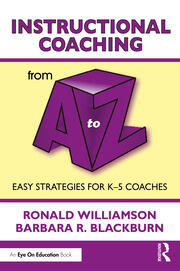 Dr. Ronald Williamson is Professor Emeritus of Educational Leadership at Eastern Michigan University. He is a former principal, central office administrator and executive director of the National Middle School Association (now AMLE). The author of numerous books on leadership, Ron is the co-author with Barbara R. Blackburn of Instructional Coaching from A to Z: Easy Strategies for K-5 Coaches (Routledge/Eye On Education), available for preorder August 3, 2026.
Dr. Barbara R. Blackburn, a “Top 10 Global Guru in Education,” is a bestselling author of over 30 books and a sought-after consultant. She was an award-winning professor at Winthrop University and has taught students of all ages. In addition to speaking at conferences worldwide, she regularly presents virtual and on-site workshops for teachers and administrators. Barbara is the author of Scaffolding for Success (Routledge/Eye On Education, 2025) and many other books and articles about teaching and leadership. Visit her website and see some of her most popular MiddleWeb articles about effective teaching here.